Typical values from 52 sampled wells in Brevard County · Full groundwater profile
What Are You Noticing in Your Water?
Pre-selected from Brevard County well data. Untick anything you do not notice in your own water.
Based on the contaminants most commonly reported in this region. Always confirm with a certified lab water test before buying equipment.
Explore Florida Interactive Map
Explore Brevard County and nearby counties
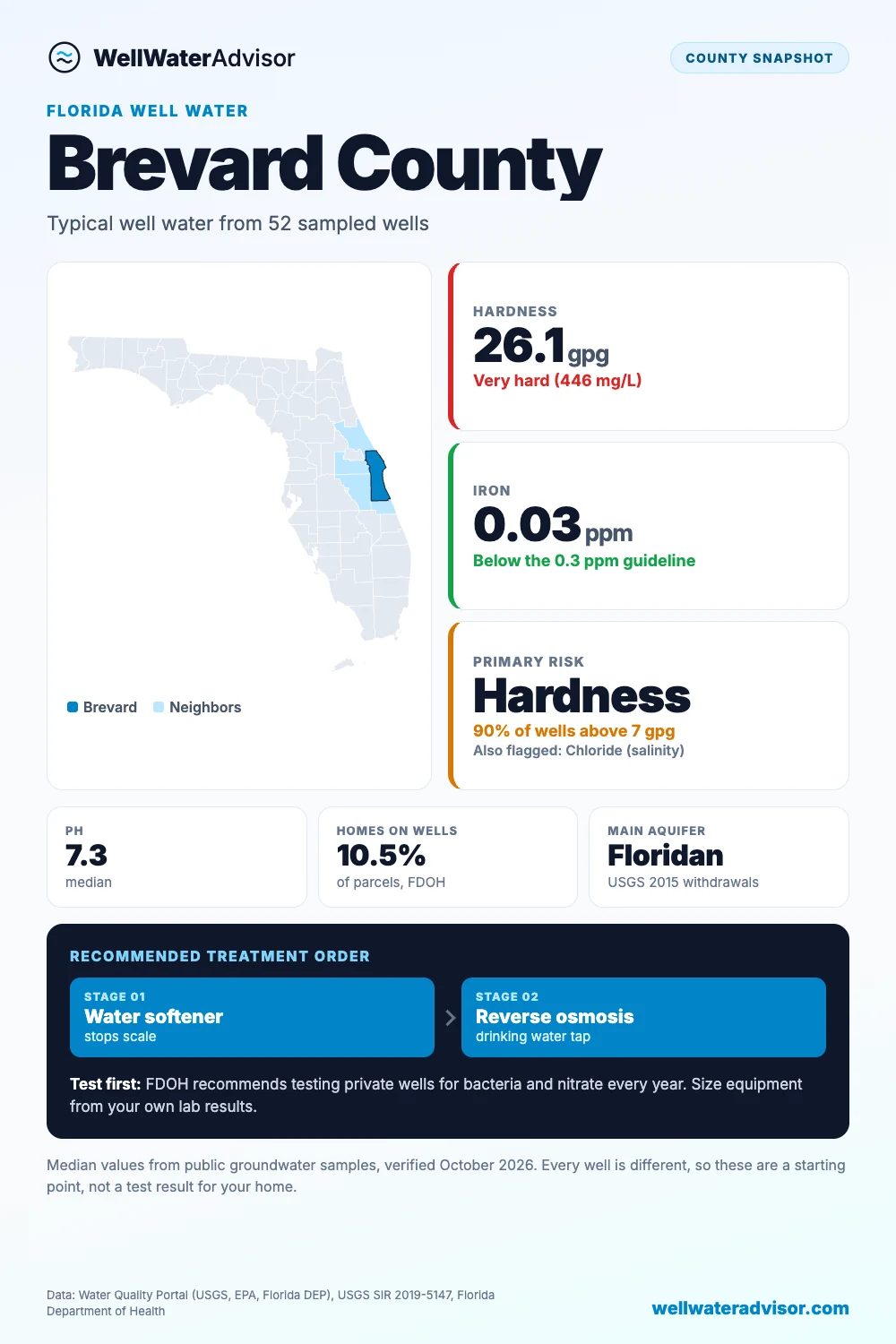
Most homes in Brevard County, in Central Florida, are on public water, but 10.5% of built parcels, roughly 26,317 properties, still draw drinking water from a private well, according to the Florida Department of Health's 2017 inventory.
Most groundwater pumped in Brevard County comes from the Floridan Aquifer (USGS, 2015 withdrawals). Samples from 52 local wells put the median hardness at 26.1 gpg (very hard) and median iron at 0.03 mg/L. The county's largest communities are Palm Bay, Melbourne and Titusville.
In this guide
Groundwater Profile: Brevard County
Most groundwater pumped in Brevard County comes from the Floridan Aquifer (USGS, 2015 withdrawals). Across 52 sampled wells, the median hardness is 26.1 gpg, which the USGS classes as very hard. It applies to wells across Brevard County, including around Palm Bay, Melbourne and Titusville.
What shows up in local well samples:
- HardnessMedian 26.1 gpg; 90% of 52 sampled wells above 7 gpg
Calcium and magnesium dissolved from limestone. Leaves scale on fixtures and water heaters and reduces soap lather. Not a health risk.
Water softener sizing - Chloride (salinity)Median chloride 485 mg/L
A salty taste and faster corrosion, often a sign of saltwater intrusion. The EPA aesthetic guideline is 250 mg/L.
Reverse osmosis guide
Hydrogen sulfide (the rotten-egg smell) was measured in only 1 Brevard County wells, too few to say how common it is. Limited local data (fewer than 20 samples): individual well testing recommended. If you notice the smell, a sulfide test confirms it.
How Brevard County Compares to Florida and the U.S.
See How Brevard County Compares to Florida & the US
| Share of wells with… | Brevard CountyBrevard | FloridaFL | United StatesUS |
|---|---|---|---|
| Hard water (above 7 gpg) | 90% | 79% | 60% |
| Iron above 0.3 mg/L | 27% | 35% | 19% |
| Manganese above 0.05 mg/L | 2% | 8% | 21% |
| Dissolved solids above 500 mg/L | 71% | 22% | 15% |
| Acidic water (pH below 6.5) | 12% | 15% | 14% |
| Nitrate above 10 mg/L (EPA limit) | Limited data | 2% | 4% |
| Arsenic above 10 µg/L (EPA limit) | 4% | 3% | 7% |
| Median hardness | 26.1 gpg | 12.4 gpg | — |
| Median pH | 7.3 | 7.2 | 7.3 |
Brevard County and Florida: share of sampled wells (all well types, samples since 2000) whose typical value exceeds the level, from the Water Quality Portal. United States: USGS Circular 1332, about 2,100 domestic wells in 48 states sampled 1991 to 2004. Well types and years differ, so read this as a broad comparison. Highlighted cells are well above the national share.
See what a typical Brevard County well needs
Opens the diagnostic calculator with Brevard County median values (26.1 gpg hardness, 0.03 ppm iron, pH 7.3) for a 3–4 person home. Swap in your own lab results for an exact plan.
Testing Your Well in Brevard County
The Florida Department of Health in Brevard County oversees private well permitting in the county and investigates suspected contamination. For routine bacteria, nitrate or full-panel tests, use a laboratory certified by the Florida Department of Health.
What to test for in Brevard County:
- Bacteria (total coliform and E. coli) and nitrate, at least once a year (Florida Department of Health recommendation)
- Hardness in grains per gallon (gpg) to size a softener
- Chloride and sodium, to catch saltwater intrusion
- After any flood, new well work or a change in taste, color or smell
The Florida Department of Health in Brevard County can explain how to collect samples and where to send them. Statewide guidance is on the FDOH private well testing page, and our guide to how to test well water covers which tests to order.
Nearby Counties
Brevard County borders these counties with published reports:
Frequently Asked Questions
How many homes in Brevard County use private wells?
The Florida Department of Health’s Florida Water Management Inventory (2017 data) found 10.5% of built parcels in Brevard County on private wells, roughly 26,317 properties.
How hard is well water in Brevard County?
Groundwater samples from 52 wells in Brevard County have a median hardness of 26.1 grains per gallon (446 mg/L), which the USGS classes as very hard. About 90% of sampled wells are above 7 gpg, the point where a water softener is usually worthwhile. The Florida statewide median is 12.4 gpg.
Is iron a problem in Brevard County well water?
The median iron level across 52 sampled wells is 0.03 mg/L, below the EPA aesthetic guideline of 0.3 mg/L, and 27% of wells exceed it. Most wells will not stain, but if yours does, a lab test tells you whether iron or manganese is the cause.
Why does my well water smell like rotten eggs in Brevard County?
Hydrogen sulfide (the rotten-egg smell) was measured in only 1 Brevard County wells, too few to say how common it is. Limited local data (fewer than 20 samples): individual well testing recommended. If you notice the smell, a sulfide test confirms it. The smell is a nuisance rather than a health risk at typical levels.
Which aquifer supplies wells in Brevard County?
Most groundwater pumped in Brevard County comes from the Floridan Aquifer (USGS, 2015 withdrawals).
Does boiling well water make it safe to drink in Brevard County?
Only if bacteria are the problem. A one-minute rolling boil kills germs, but it does not remove nitrate, arsenic or other chemicals, and it concentrates them as water evaporates. Test first, and see our boiling well water myth buster for when boiling helps.
How often should I test my well water in Brevard County?
The Florida Department of Health recommends testing private wells for bacteria and nitrate at least once a year, and again after flooding or well repairs. The Florida Department of Health in Brevard County can explain how to collect and submit samples.
Written by Well Water Advisor Editorial Team.