This guide contains affiliate links. As an Amazon Associate we earn from qualifying purchases, at no extra cost to you. Read our full affiliate disclosure.
In this guide
Where the Myth Comes From
Most people learn about boiling water from a boil water advisory. A town main breaks or a storm floods a treatment plant, the notice says to boil before drinking, and the lesson that sticks is simple: boiled water is safe water. For city water, where the only short-term worry is germs, that is close enough to true.
A private well is different. Nobody treats it but you, and the problems found in wells are just as often chemical as biological: nitrate from fertilizer and septic systems, arsenic from bedrock, lead from old plumbing. The CDC’s own boil water guidance says it plainly: “Boiling does NOT remove chemicals.”
The confusion shows up constantly online. When someone asked on r/explainlikeimfive whether boiling removes lead and copper, the top reply was blunt:
“No, not at all. If anything the ppm of lead and copper in the now boiled water will be higher. Lead and copper don’t boil at conditions you will normally encounter in your life. If you boil water with metals in it, you will evaporate some water and leave all the metal behind.”
Top reply, r/explainlikeimfive
On r/biology, a reader whose water had turned green asked whether boiling it was enough. The most upvoted answer, with more than 300 votes, made the same point:
“Boiling water for 10 minutes may sterilize it, but not destroy chemical pollutants. Boiling water does not purify it.”
Top reply, r/biology
That reply was right about chemicals but long on time. Other commenters in the thread pointed out that you do not need 10 minutes, and the CDC agrees: one minute at a rolling boil is enough to kill germs, or three minutes above 6,500 feet. Longer boiling does not make water cleaner. It just boils off more water and concentrates whatever chemicals are left.
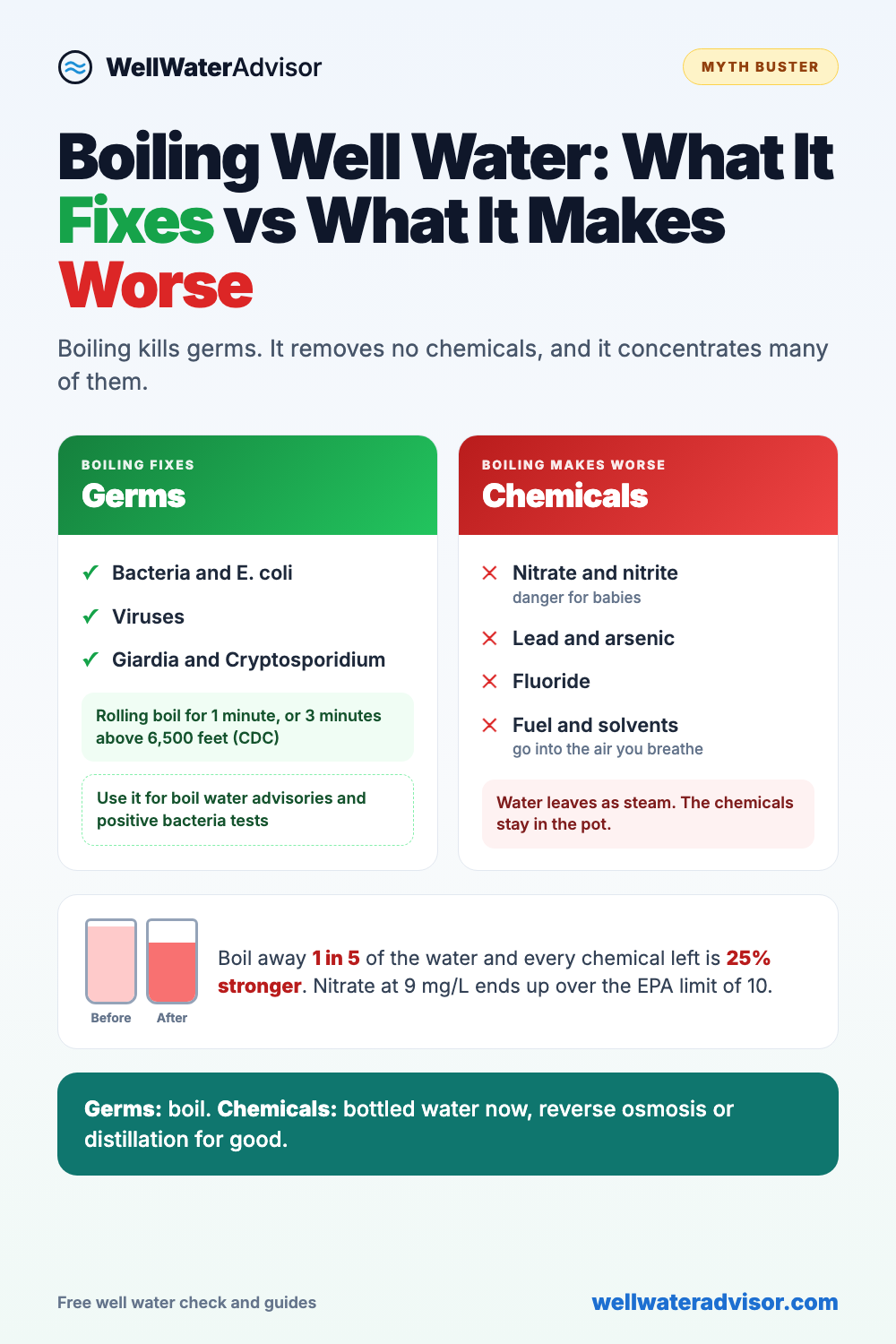
What Boiling Kills and What It Leaves Behind
Boiling is a heat treatment. It works on anything that is alive and leaves everything else where it is.
Boiling kills
- Bacteria, including E. coli and total coliform
- Viruses, such as norovirus and hepatitis A
- Parasites, including Giardia and Cryptosporidium
Boiling does not remove
- Nitrate and nitrite
- Lead, arsenic, copper, uranium and other metals
- Fluoride and salts
- Pesticides and most other chemicals
- Fuel and solvents (VOCs): some escape into the air you breathe
Killed bacteria also leave behind whatever made the water unsafe in the first place. A positive bacteria test on a well usually means surface water is getting in through a cracked casing, a loose well cap or flooding. Boiling makes tonight’s glass safe; it does not fix the well. Our guide to coliform bacteria in well water covers finding the source.
The Concentration Effect: Why Boiling Makes Chemicals Worse
Lead, arsenic, nitrate and fluoride do not boil away at kitchen temperatures. Water does. Every minute at a boil turns some of the water into steam while the dissolved chemicals stay in the pot, so the same amount of contaminant ends up in less water. Concentration is mass divided by volume: keep the mass fixed, shrink the volume, and the concentration rises.
How much water you lose depends on the pot, the burner and how long it boils, but the math is the same every time:
| Water boiled away | Concentration goes up by | Nitrate starting at 9 mg/L becomes |
|---|---|---|
| 1 in 10 (10%) | 11% | 10.0 mg/L, right at the limit |
| 1 in 5 (20%) | 25% | 11.3 mg/L, over the EPA limit |
| 1 in 3 (33%) | 50% | 13.5 mg/L, well over the limit |
| Half (50%) | 100% | 18.0 mg/L, nearly double the limit |
The EPA limit for nitrate is 10 mg/L (measured as nitrogen). A well that tests just under it can be pushed over by a long boil, and a kettle left to boil hard and topped up again and again keeps concentrating the same water. Virginia’s health department, summarizing CDC guidance, warns that because some water evaporates, nitrate levels “can actually increase slightly” when water is boiled.
Contaminant by Contaminant
| Contaminant | What boiling does | EPA limit | What removes it |
|---|---|---|---|
| Bacteria, viruses, parasites | Kills them | Zero E. coli | Boiling short term; shock chlorination and UV |
| Nitrate and nitrite | Concentrates | 10 mg/L nitrate-N, 1 mg/L nitrite-N | Reverse osmosis, distillation, anion exchange |
| Lead | Concentrates | Health goal of zero | Filters certified to NSF/ANSI 53 or 58 |
| Arsenic | Concentrates | 10 ppb | Reverse osmosis or arsenic media, often with oxidation first |
| Fluoride | Concentrates | 4 mg/L | Reverse osmosis, distillation, activated alumina |
| Fuel and solvents (VOCs) | Partly airborne, inhalation risk | Varies by chemical | Activated carbon, sized by a pro |
| Pesticides | Not removed | Varies by chemical | Activated carbon, reverse osmosis |
| Chlorine, hydrogen sulfide | Gas escapes | Taste and odor only | Carbon; aeration or oxidation for sulfur |
| Microplastics | Partly trapped in hard water scale | None set | Reverse osmosis, fine filtration |
Nitrate and nitrite: the biggest risk for infants
Nitrate is the contaminant where boiling does the most harm, because the people most likely to boil water are often preparing it for a baby. In infants under six months, nitrate is converted to nitrite, which reduces the blood’s ability to carry oxygen. The condition, methemoglobinemia, is known as blue baby syndrome. Florida’s health department advises that well water above 10 mg/L nitrate should not be given to infants under six months, straight or in formula, and warns specifically against boiling it.
Lead, arsenic and other metals
The EPA answers this one directly: “No, boiling water does not remove lead.” Metals have boiling points in the thousands of degrees, so every drop of water that leaves as steam makes what remains slightly more toxic. The same goes for arsenic, which occurs naturally in bedrock wells across much of the country, and for copper, uranium and manganese.
Fuel, solvents and other VOCs
Volatile organic compounds such as benzene and TCE are the one group where boiling does pull some chemical out of the water, and that is the problem. It moves into your kitchen air, where you breathe it, and boiling does not reliably remove all of it. That is why official notices after wildfire damage to water systems, such as the 2025 Eaton Fire in Los Angeles County, read “do not drink, do not boil” and also tell people to keep showers short and lukewarm. If your well smells like gasoline or solvent, stop using it for drinking and cooking and call your county health department.
A correction on microplastics
Microplastics are often lumped in with chemicals that boiling concentrates, but the best evidence so far points the other way. A 2024 study in Environmental Science & Technology Letters found that boiling hard water and pouring it through a simple filter removed 84 to 90 percent of added nano and microplastics, because the particles get trapped in the calcium carbonate scale that forms as water heats. In soft water only about a quarter were removed. It is an encouraging side effect, not a reason to rely on boiling for anything else.
Boiling Well Water for Baby Formula
Parents get conflicting advice here, and it shows. In a long r/newborns thread asking “Do you boil your babys formula water?”, one parent summed up the confusion: “Our pediatrician told us to boil the water but I keep hearing different things from different people.” Further down, another asked the question that matters most for rural families, “I’m curious if anyone on well water does.” That question deserves a direct answer.
Part of the answer came from a parent in the same thread who uses distilled water and heats it anyway: “The heated water kills any potential cronobactor in the powdered formula, it is not to purify the water since we’re already using distilled.” That is the key distinction. Hot water for formula is mainly about germs that can live in the powder, such as Cronobacter. It does nothing about nitrate or lead in the water itself, and boiling the same water for a long time makes those worse.
For a baby on a private well, the safe order is: test the well for nitrate and bacteria before using it for formula, use bottled water until you have results, and never use well water above 10 mg/L nitrate for formula, boiled or not. If the water is clean, follow your pediatrician and the formula label on heating it, and bring it to a boil only briefly.
When Boiling Is the Right Call
Boiling is the right emergency tool when the only problem is germs:
- A boil water advisory from your health department after flooding, a main break or an outbreak.
- A positive bacteria test on your well, while you arrange shock chlorination and a retest. Our shock chlorination calculator gives the bleach dose for your well.
- After flooding or well work such as a pump replacement, until a lab confirms the water is clear of bacteria.
Follow the CDC method: if the water is cloudy, let it settle or filter it through a clean cloth first, bring it to a rolling boil for 1 minute (3 minutes above 6,500 feet), let it cool and store it in a clean, covered container. Do not boil water that also has a nitrate, lead, arsenic or fuel problem. Use bottled water instead.
Can I Boil My Water? Check Yours
Tick what your test found. If you have a nitrate number, add it to see how much boiling would raise it.
Interactive check
Can I Boil My Water?
Tick everything your test or health department flagged. The check tells you whether boiling helps, does nothing or makes the water worse.
Nitrate on lab reports is usually listed as nitrate-nitrogen (NO3-N); the EPA limit is 10 mg/L.
Boiling vs Reverse Osmosis vs Distillation vs UV
No single method covers everything, which is why most wells with both a bacteria and a chemical problem end up with two stages: UV at the point of entry for germs, and reverse osmosis at the kitchen tap for drinking water.
| Problem | Boiling | Reverse osmosis | Distillation | UV light |
|---|---|---|---|---|
| Bacteria and viruses | Kills | Removes most, not a disinfection step | Yes | Kills, needs clear water |
| Giardia and Cryptosporidium | Kills | Removes | Yes | Inactivates |
| Nitrate and nitrite | Concentrates | Removes | Removes | No |
| Lead and arsenic | Concentrates | Removes | Removes | No |
| Fluoride | Concentrates | Removes | Removes | No |
| VOCs and pesticides | Partly airborne | Mostly, via its carbon stages | Partly, some carry over | No |
| How much water | A pot at a time | Kitchen tap, all day | A few gallons a day | Whole house |
| Best use | Emergencies, germs only | Drinking and cooking water | Small households, no plumbing | Ongoing bacteria protection |
UV needs clean, clear water to work: iron, manganese, hardness and sediment shield germs from the light, so a sediment filter (and an iron filter if needed) goes in front of it. Reverse osmosis is a point-of-use system for one tap; if a chemical problem affects the whole house, see our guide to whole house RO for well water.
Step 0: Confirm Your Numbers
Boiling is only safe if germs are the whole problem, so find out what is in the water first. DIY screening: a 16-in-1 or 17-in-1 well water test strip kit reads nitrate, nitrite and pH in minutes. Certified testing: strips cannot detect bacteria, lead or arsenic reliably, so use a state-certified drinking water lab for those, especially before using well water for a baby. Our guide explains how to test well water step by step.
Equipment That Actually Fixes the Problem
These are the equipment types this guide recommends. We have not tested individual models hands-on. Where we name a model, its specs come from the manufacturer’s published information; the links open Amazon listings so you can compare current models against your test results.
The real fix for nitrate, lead and arsenic
Express Water RO5DX Under-Sink Reverse Osmosis
5-stage RO for the kitchen tap; Express Water says the RO5DX is NSF certified.
- Removes nitrate, lead, arsenic and fluoride that boiling concentrates
- Needs 40 to 80 psi, so check your pressure tank setting
Ongoing bacteria protection
SpringWell UV Water Purification System
Whole house UV rated at 15 GPM by SpringWell; kills germs at every tap.
- Replaces boiling for recurring bacteria, no chemicals
- Does not remove nitrate, lead or arsenic
Required before UV
Whole House Sediment Filter
Clears sand and silt that shield bacteria from UV light.
- Protects the UV lamp sleeve and RO membrane
- Low-cost cartridges, quick swaps
For fuel, solvents and pesticides
Whole House Carbon Filter
Activated carbon for VOCs and pesticides; have a pro size it for a spill.
- Treats the chemicals boiling sends into the air
- Also improves chlorine taste and odor
Frequently Asked Questions
Does boiling water purify well water?
Only partly. A rolling boil kills bacteria, viruses and parasites, but it removes no chemicals. Nitrate, lead, arsenic and fluoride stay in the water and become more concentrated as it evaporates, so boiling is only a fix when germs are the whole problem.
Does boiling water remove nitrates?
No. Nitrate does not boil off, so boiling raises its concentration as water evaporates. Boil away a fifth of the water and nitrate goes up by 25 percent. Reverse osmosis, distillation or anion exchange remove nitrate.
Does boiling water remove lead?
No. The EPA states that boiling water does not remove lead, and because water evaporates while lead stays behind, boiled water can contain more lead per glass. Use a filter certified to NSF/ANSI 53 or 58 for lead.
How long should I boil well water to kill bacteria?
The CDC recommends a rolling boil for 1 minute, or 3 minutes at elevations above 6,500 feet. Boiling longer does not make the water safer; it only boils off more water and concentrates any chemicals.
Can I use boiled well water for baby formula?
Only if the well has been tested and nitrate is under 10 mg/L. Boiling kills germs but concentrates nitrate, which is dangerous for infants under six months. Use bottled water until a lab test confirms the well is safe.
Is it safe to boil water that smells like gasoline?
No. Boiling water with fuel or solvent chemicals (VOCs) releases them into the air you breathe and does not reliably remove them. Stop drinking the water, use bottled water and contact your county health department.
Sources and How We Researched This
This guide was compiled by the WellWaterAdvisor editorial team from CDC, EPA and state health department guidance and peer-reviewed research. Community quotes are reproduced from public Reddit threads and credited to the subreddit they were posted in. This guide is general information, not medical advice: if you are worried about a baby’s exposure, talk to your pediatrician.
- CDC: Boil Water Advisory (boil times and “Boiling does NOT remove chemicals”)
- EPA: Does boiling water remove lead?
- EPA: National Primary Drinking Water Regulations (limits for nitrate, arsenic, fluoride and lead)
- Virginia Department of Health: Nitrate in Private Wells (CDC and ATSDR material on boiling and infants)
- Florida Department of Health: Well Water Facts, Nitrate
- Yu, Z. et al., Drinking Boiled Tap Water Reduces Human Intake of Nanoplastics and Microplastics, Environmental Science & Technology Letters, 2024
- Kinneloa Irrigation District: Do Not Drink, Do Not Boil order (VOC exposure guidance issued with state and county health officials)
- SpringWell UV Water Purification and Express Water product information (manufacturer specifications)
Related tools: shock chlorination calculator, well water diagnostic calculator, how to test well water.