Typical values from 63 sampled wells in Hernando County · Full groundwater profile
What Are You Noticing in Your Water?
Pre-selected from Hernando County well data. Untick anything you do not notice in your own water.
Based on the contaminants most commonly reported in this region. Always confirm with a certified lab water test before buying equipment.
Explore Florida Interactive Map
Explore Hernando County and nearby counties
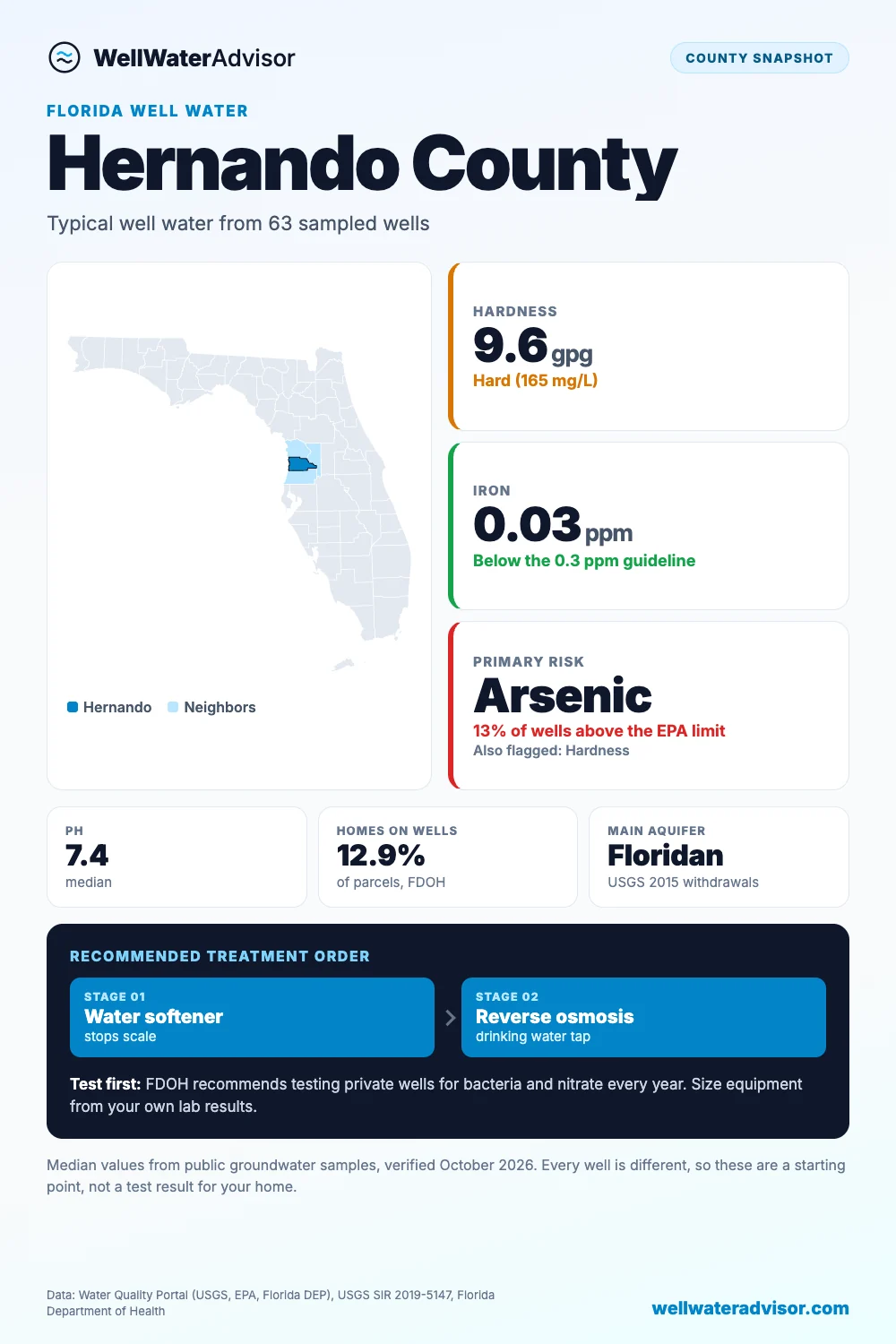
Most homes in Hernando County, on Florida’s Nature Coast, are on public water, but about one in eight still are not: 12.9% of built parcels, roughly 10,858 properties, draw drinking water from an onsite private well, according to the Florida Department of Health’s 2023 inventory.
Hernando County is home to Weeki Wachee Springs, one of the best-known springs fed by the Floridan Aquifer, which supplies both the county’s public utilities and its private wells. That geology shapes which well water problems show up most often here.
In this guide
Groundwater Profile: Hernando County
Most groundwater pumped in Hernando County comes from the Floridan Aquifer (USGS, 2015 withdrawals). Across 63 sampled wells, the median hardness is 9.6 gpg, which the USGS classes as hard. It applies to wells across Hernando County, including around Brooksville, Spring Hill and North Weeki Wachee.
What shows up in local well samples:
- HardnessMedian 9.6 gpg; 83% of 63 sampled wells above 7 gpg
Calcium and magnesium dissolved from limestone. Leaves scale on fixtures and water heaters and reduces soap lather. Not a health risk.
Water softener sizing - ArsenicFound above the drinking water limit locally. Limited local data (fewer than 20 samples): individual well testing recommended.
Odorless and tasteless, with an EPA limit of 10 µg/L. Only a lab test detects it.
How to test your well
Hydrogen sulfide (the rotten-egg smell) was measured in only 3 Hernando County wells, too few to say how common it is. Limited local data (fewer than 20 samples): individual well testing recommended. If you notice the smell, a sulfide test confirms it.
How Hernando County Compares to Florida and the U.S.
See How Hernando County Compares to Florida & the US
| Share of wells with… | Hernando CountyHernando | FloridaFL | United StatesUS |
|---|---|---|---|
| Hard water (above 7 gpg) | 83% | 79% | 60% |
| Iron above 0.3 mg/L | 22% | 35% | 19% |
| Manganese above 0.05 mg/L | 2% | 8% | 21% |
| Dissolved solids above 500 mg/L | 24% | 22% | 15% |
| Acidic water (pH below 6.5) | 3% | 15% | 14% |
| Nitrate above 10 mg/L (EPA limit) | Limited data | 2% | 4% |
| Arsenic above 10 µg/L (EPA limit) | Limited data | 3% | 7% |
| Median hardness | 9.6 gpg | 12.4 gpg | — |
| Median pH | 7.4 | 7.2 | 7.3 |
Hernando County and Florida: share of sampled wells (all well types, samples since 2000) whose typical value exceeds the level, from the Water Quality Portal. United States: USGS Circular 1332, about 2,100 domestic wells in 48 states sampled 1991 to 2004. Well types and years differ, so read this as a broad comparison. Highlighted cells are well above the national share.
See what a typical Hernando County well needs
Opens the diagnostic calculator with Hernando County median values (9.6 gpg hardness, 0.03 ppm iron, pH 7.4) for a 3–4 person home. Swap in your own lab results for an exact plan.
Testing Your Well in Hernando County
Private well owners can bring water samples for bacteriological testing to the Florida Department of Health in Hernando County Spring Hill Environmental Division (7551 Forest Oaks Blvd., Spring Hill, 352-540-6812). Samples are accepted Tuesday through Thursday, 7:30 to 11 a.m., and must be collected that morning in sterilized bags provided by the office.
For nitrates, metals, or a full panel, use a laboratory certified by the Florida Department of Health. The state’s private well water testing guide explains which tests to order and how to find a certified lab near you.
What to test for in Hernando County:
- Bacteria (total coliform and E. coli) and nitrate, at least once a year (Florida Department of Health recommendation)
- Hardness in grains per gallon (gpg) to size a softener
- Arsenic, which appeared above the EPA limit in some sampled wells here
- After any flood, new well work or a change in taste, color or smell
The Florida Department of Health in Hernando County can explain how to collect samples and where to send them. Statewide guidance is on the FDOH private well testing page, and our guide to how to test well water covers which tests to order.
Nearby Counties
Hernando County borders these counties with published reports:
Frequently Asked Questions
How hard is well water in Hernando County?
Groundwater samples from 63 wells in Hernando County have a median hardness of 9.6 grains per gallon (165 mg/L), which the USGS classes as hard. About 83% of sampled wells are above 7 gpg, the point where a water softener is usually worthwhile. The Florida statewide median is 12.4 gpg.
Is iron a problem in Hernando County well water?
The median iron level across 63 sampled wells is 0.03 mg/L, below the EPA aesthetic guideline of 0.3 mg/L, and 22% of wells exceed it. Most wells will not stain, but if yours does, a lab test tells you whether iron or manganese is the cause.
Why does my well water smell like rotten eggs in Hernando County?
Hydrogen sulfide (the rotten-egg smell) was measured in only 3 Hernando County wells, too few to say how common it is. Limited local data (fewer than 20 samples): individual well testing recommended. If you notice the smell, a sulfide test confirms it. The smell is a nuisance rather than a health risk at typical levels.
Which aquifer supplies wells in Hernando County?
Most groundwater pumped in Hernando County comes from the Floridan Aquifer (USGS, 2015 withdrawals).
Does boiling well water make it safe to drink in Hernando County?
Only if bacteria are the problem. A one-minute rolling boil kills germs, but it does not remove nitrate, arsenic or other chemicals, and it concentrates them as water evaporates. Test first, and see our boiling well water myth buster for when boiling helps.
How many homes in Hernando County use private wells?
The Florida Department of Health’s 2023 Florida Water Management Inventory found 12.9% of built parcels in Hernando County on private wells, roughly 10,858 properties. Most of the county’s built parcels are served by public water systems; private wells are most common on rural lots and older properties outside utility service areas.
Where can I get my well water tested in Hernando County?
The DOH-Hernando Spring Hill Environmental Division (7551 Forest Oaks Blvd.) accepts private well samples for bacteria testing Tuesday through Thursday mornings, in sterile bags from their office. For nitrates or metals, use an FDOH-certified commercial lab.
Do I need to test my well water if my neighbors say theirs is fine?
Yes. Well depth, casing condition, and the exact aquifer layer tapped can vary block to block, so one neighbor’s clean test does not guarantee another’s. A full annual test is the only reliable way to know what is in your own water.
Is Floridan Aquifer water generally safe to drink untreated?
Much of it is chemically safe but aesthetically unpleasant (hard, sulfur-smelling, or iron-stained), which is why treatment here is usually about comfort and plumbing protection rather than an acute health risk. A lab test is still the only way to rule out bacteria, nitrates, or other contaminants specific to your well.
Written by Well Water Advisor Editorial Team.