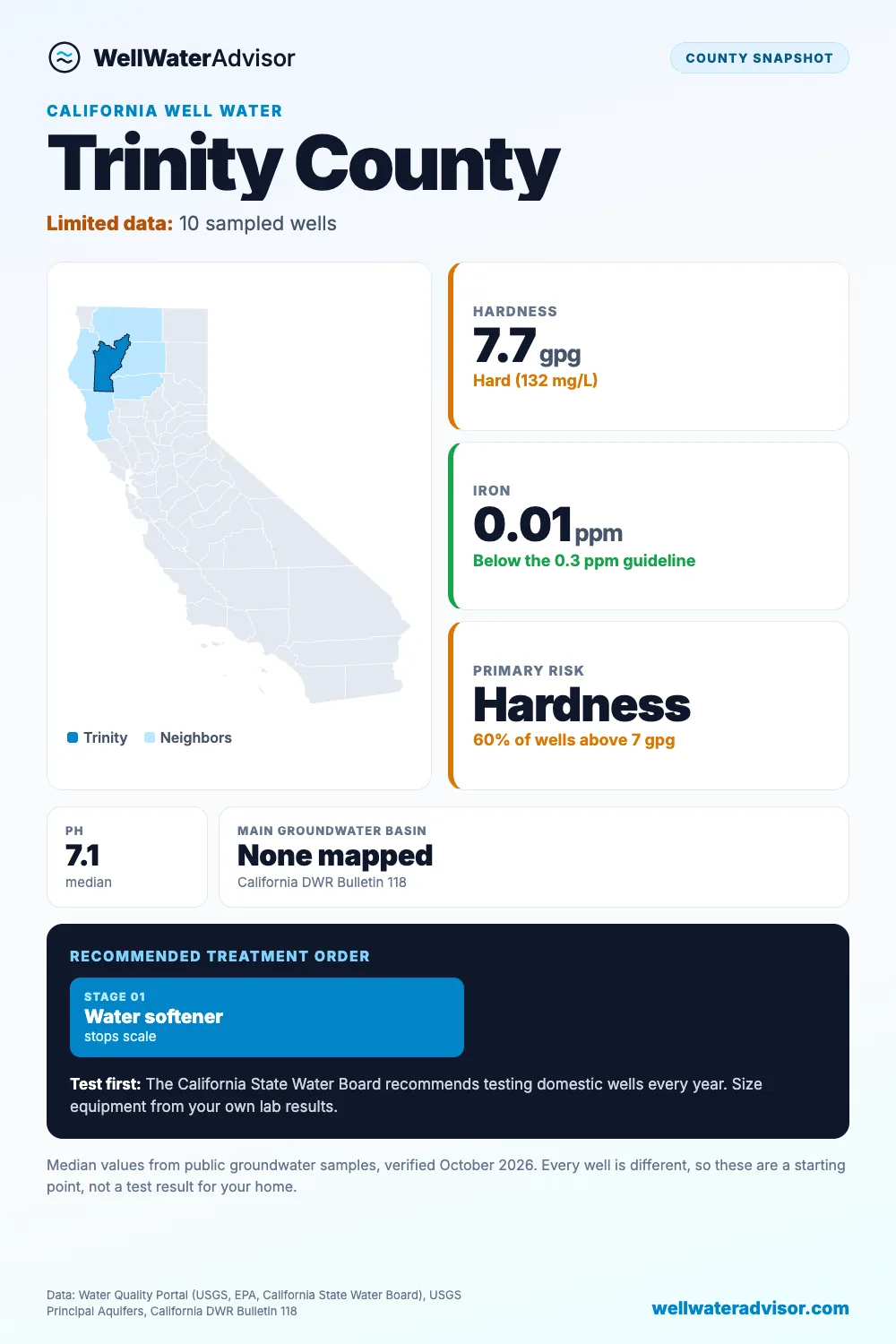
Typical values from 10 sampled wells in Trinity County · Full groundwater profile
Quick Answers for Trinity County Well Owners
No common nuisance problem in the typical well. The typical Trinity well is hard, with iron below the stain threshold and a pH of 7.1.
Drink it untreated? Generally yes in the records, though only your own test covers your well.
Typical treatment, in plumbing order:
Usually nothing beyond routine testing. Most Trinity wells need no softener or iron filter, so test before buying equipment.
Not sure what to install? Get a filter recommendation for Trinity County homesIf your water comes from a utility, its annual Consumer Confidence Report is the right source; the figures here are for private wells. Find your utility's report
On this page (8 sections)
Where to Test Well Water in Trinity County
- Your county environmental health department handles private well questions in Trinity County; for a water test, use a state-accredited lab, many of which accept mailed or dropped-off samples.
- Certified labs: State Water Board list of accredited labs (ELAP)
Ask the lab for sample bottles and how quickly the sample must reach it before you collect.
What Are You Noticing in Your Water?
Confirm with a lab test before buying equipment.
Explore California Interactive Map
Explore Trinity County and nearby counties
Trinity County has about 16,000 residents. Homes outside city and community water systems rely on private domestic wells. Wells here draw from small local groundwater basins and fractured bedrock, so water quality can change a lot from one property to the next.
Across 10 sampled wells, groundwater is hard (7.7 gpg in the typical well). Arsenic, nitrate and chromium-6 were below California limits in most sampled wells, but individual wells vary, so test yours.
In this guide
Groundwater Profile: Trinity County
Most groundwater pumped in Trinity County comes from the local groundwater basins and fractured bedrock (USGS Principal Aquifers map). Across 10 sampled wells, the median hardness is 7.7 gpg, which the USGS classes as hard.
Another address? Check hardness by ZIP code.
What shows up in local well samples:
- HardnessLimited local data (fewer than 20 samples): individual well testing recommended.
Calcium and magnesium dissolved from limestone. Leaves scale on fixtures and water heaters and reduces soap lather. Not a health risk.
Water softener sizing
Arsenic, Nitrate, Chromium-6 and Salinity in Trinity County
| Contaminant | Typical well | Wells above limit | California standard |
|---|---|---|---|
| Arsenic | 0.2 µg/L | Limited data (10 wells) | 10 µg/L (primary MCL) |
| Nitrate (as nitrogen) | 0.08 mg/L | Limited data (10 wells) | 10 mg/L (primary MCL) |
| Chromium-6 | No data | No data | 10 µg/L (primary MCL since Oct. 1, 2024) |
| Salinity (dissolved solids) | 177 mg/L | Limited data (10 wells) | 500 mg/L recommended, 1,000 mg/L upper (secondary) |
| Hardness | 7.7 gpg | Limited data (10 wells) | No limit; above 7 gpg is hard |
Typical well = median. Standards: State Water Board; samples: Water Quality Portal, since 2000.
How Trinity County Compares to California and the U.S.
See How Trinity County Compares to California & the US
| Share of wells with… | Trinity CountyTrinity | CaliforniaCA | United StatesUS |
|---|---|---|---|
| Hard water (above 7 gpg) | Limited data | 64% | 60% |
| Iron above 0.3 mg/L | Limited data | 9% | 19% |
| Manganese above 0.05 mg/L | Limited data | 22% | 21% |
| Dissolved solids above 500 mg/L | 0% | 38% | 15% |
| Acidic water (pH below 6.5) | 20% | 2% | 14% |
| Nitrate above 10 mg/L (EPA limit) | Limited data | 9% | 4% |
| Arsenic above 10 µg/L (EPA limit) | Limited data | 14% | 7% |
| Chromium-6 above 10 µg/L (California limit) | No data | 6% | — |
| Median hardness | 7.7 gpg | 9.9 gpg | — |
| Median pH | 7.1 | 7.6 | 7.3 |
Sources: Water Quality Portal (since 2000); US: USGS Circular 1332. Highlighted: well above the US share.
See what a typical Trinity County well needs
Pre-filled with the Trinity medians. Swap in your own results.
Testing Your Well in Trinity County
In California, county environmental health departments handle private well permits and can advise on testing. For bacteria, nitrate, arsenic or a full panel, use a laboratory accredited by California’s Environmental Laboratory Accreditation Program (ELAP); the State Water Board’s certified lab map lists them.
What to test for in Trinity County:
- Bacteria (total coliform and E. coli), nitrate and arsenic, at least once a year (California State Water Resources Control Board recommendation)
- Hardness in grains per gallon (gpg) to size a softener
- After any flood, new well work or a change in taste, color or smell
Which tests to order and how: how to test well water.
After a positive coliform test, shock the well with the right bleach dose and retest 10 to 14 days later.
Nearby Counties
Trinity County borders these counties with published reports:
Humboldt County
8.6 gpg hardness · Hardness, Hydrogen sulfideMendocino County
6.5 gpg hardnessShasta County
4.3 gpg hardnessSiskiyou County
8.5 gpg hardness · HardnessTehama County
6.7 gpg hardness · Chromium-6Counties with similar well water
Elsewhere in California, these counties have well water like Trinity County:
Frequently Asked Questions
Is well water in Trinity County safe to drink?
Usually, as far as public records go: no health-based limit is commonly exceeded across 10 sampled Trinity wells. Still test for bacteria and nitrate every year, because county data cannot vouch for a single well.
How hard is well water in Trinity County?
Groundwater samples from 10 wells in Trinity County have a median hardness of 7.7 grains per gallon (132 mg/L), which the USGS classes as hard. Limited local data (fewer than 20 samples): individual well testing recommended. The California statewide median is 9.9 gpg.
Is iron a problem in Trinity County well water?
The median iron level across 10 sampled wells is 0.01 mg/L, below the EPA aesthetic guideline of 0.3 mg/L (limited local data (fewer than 20 samples): individual well testing recommended). Most wells will not stain, but if yours does, a lab test tells you whether iron or manganese is the cause.
Why does my well water smell like rotten eggs in Trinity County?
Too few Trinity wells (0) have hydrogen sulfide results to say how common the smell is. If you notice it, a sulfide test confirms it. At typical levels it is a nuisance rather than a health risk.
Can I install a salt-based water softener in Trinity County?
Usually, but check local rules first. California Water Code Section 13148 lets some local sewer and water recycling agencies limit or ban new salt-discharging softeners to protect recycled water. Homes on septic systems should ask the county environmental health department about brine. A salt-free conditioner discharges no brine, but it reduces scale rather than softening the water.
Does boiling well water make it safe to drink in Trinity County?
For a bacteria problem, yes: boil for one minute (three above 6,500 feet). For anything chemical, no, because evaporation concentrates it. Our boiling well water myth buster explains the difference.
How often should I test my well water in Trinity County?
The California State Water Resources Control Board recommends testing domestic wells every year, including for bacteria, nitrate and arsenic, and again after flooding or well repairs.
Written by Well Water Advisor Editorial Team.