This guide contains affiliate links. As an Amazon Associate we earn from qualifying purchases, at no extra cost to you. Read our full affiliate disclosure.
In this guide
Where the Myth Comes From
Search “does a water softener remove iron” and you get two answers that sound like they contradict each other. Softener brands say yes, their units handle iron. Iron filter brands say no, softeners are the wrong tool. Both are partly right, because “iron” in well water is not one thing.
Homeowners usually find out the hard way: the softener handles the rust stains at first, then over a year or two the stains creep back, the water picks up a metallic taste and the salt bill goes up. Nothing is broken. The softener was asked to do a job it can only do under narrow conditions, and the resin inside it slowly fouled.
Water treatment professionals describe the same pattern. In a long r/WaterTreatment discussion about softening high-iron water, the consensus was that everything starts with one question: what kind of iron do you have?
The 4 Kinds of Iron in Well Water (and Which a Softener Handles)
The EPA sets a secondary (aesthetic) guideline of 0.3 mg/L for iron, which is the same as 0.3 ppm. Above that level water starts to stain fixtures and laundry. How you remove it depends on which form it takes:
| Iron type | What you see | Softener? | What works |
|---|---|---|---|
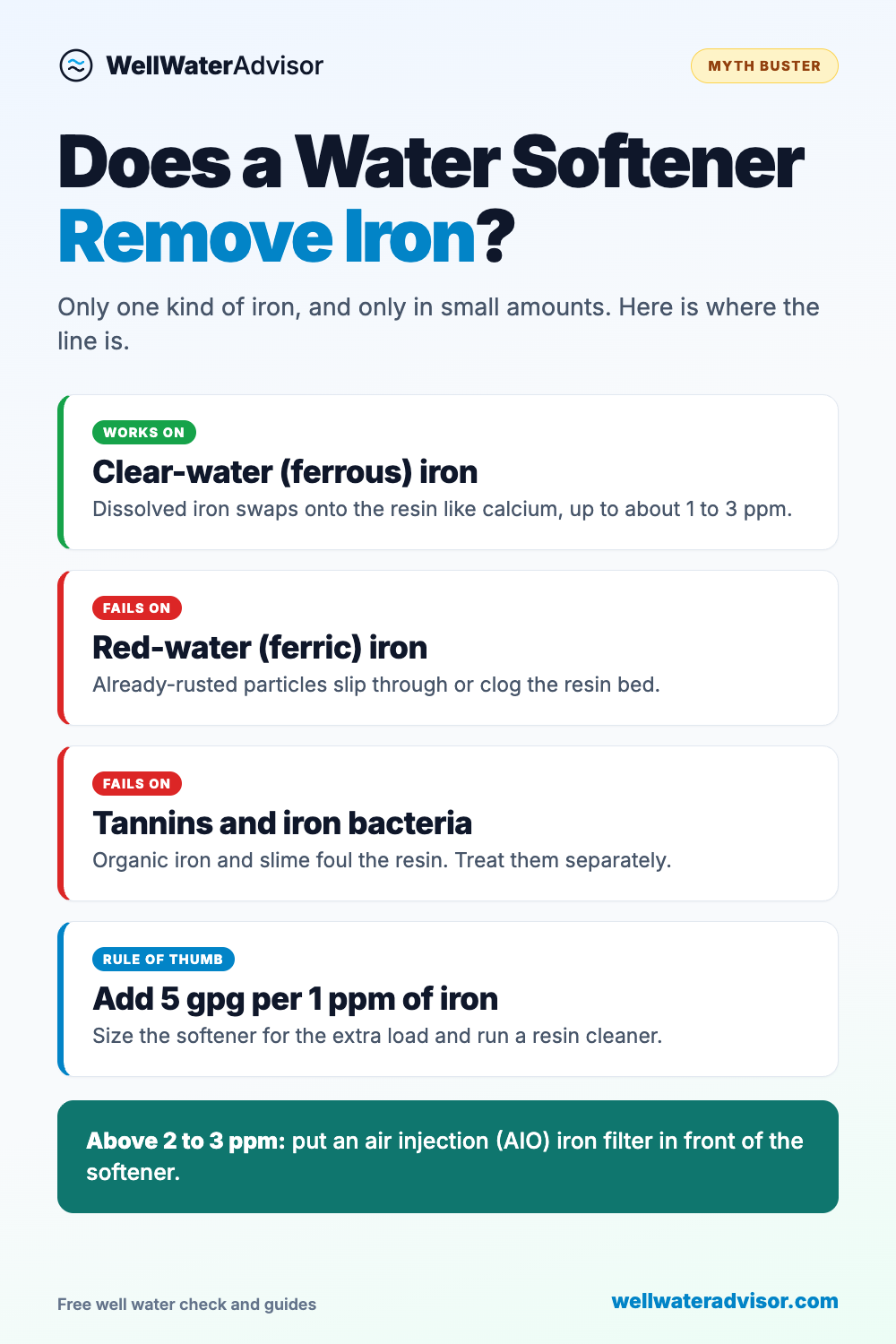
| Ferrous (clear-water) | Water runs clear, then turns orange after sitting in a glass for a few hours | Yes, at low levels (about 1 to 3 ppm) | Softener at low levels, AIO or greensand filter above that |
| Ferric (red-water) | Orange or red straight from the tap; particles settle to the bottom | No | Oxidizing iron filter or sediment filtration |
| Organic (tannin-bound) | Yellow or tea colored water that never settles | No | Anion tannin filter, confirmed by a lab test |
| Iron bacteria | Red or brown slime in the toilet tank, swampy or oily smell | No, it fouls the resin | Shock chlorination, then continuous treatment if it returns |
The glass test: fill a clear glass with cold water straight from the kitchen tap and leave it on the counter. If it comes out clear and turns orange over a couple of hours, the iron was dissolved (ferrous) and oxidized when it met air. If it is already colored and the rust settles, the iron was oxidized (ferric) before it reached your tap. A yellow tint that never settles points to tannins. Our full guide to iron in well water covers health and staining questions in more depth.
The Chemistry: How a Softener Removes Ferrous Iron
A water softener is a tank of cation-exchange resin: small plastic beads loaded with sodium (or potassium) ions. As hard water flows through, the beads grab positively charged ions and release sodium in their place. Calcium (Ca2+) and magnesium (Mg2+) are the targets, but dissolved ferrous iron (Fe2+) carries the same +2 charge, so the resin grabs it too. When the softener regenerates, concentrated brine pushes the captured ions off the beads and down the drain.
Ferric iron (Fe3+) is different. It has already reacted with oxygen and formed insoluble rust particles. There is no dissolved ion left to exchange, so the particles either pass straight through or lodge in the resin bed like sediment. Brine does not dissolve them, so they stay.
That is also why iron counts against softener capacity. A common sizing rule of thumb is to add about 5 grains per gallon (gpg) of hardness for every 1 ppm of ferrous iron. Pros who work with high-iron wells call it a good rule of thumb rather than an exact figure, and note it can be adjusted down a little when overall hardness is low. So water with 12 gpg hardness and 2 ppm iron should be sized as if it were 22 gpg.
Cation Resin Fouling: Why Softeners Struggle Above 2 to 3 ppm
Ferrous iron only stays exchangeable while it stays dissolved. Inside a real softener it rarely stays that way. Air drawn in during brining, any chlorine in the line, and the oxygen already in the water all oxidize part of the iron inside the resin bed. That iron turns into ferric particles that coat the beads, and regeneration brine cannot strip it off. This is called resin fouling, and it builds up gradually:
- Capacity drops: coated beads have fewer exchange sites, so hardness and iron start leaking through between regenerations.
- Salt use climbs: the softener regenerates more often to keep up.
- The bed clogs and channels: iron sludge packs the resin, water finds the easy path around it, and treatment becomes patchy.
- The resin wears out early: badly fouled resin often needs replacing years ahead of schedule.
The more iron enters the tank, the faster this happens. That is why most residential softener spec sheets cap iron somewhere around 1 to 3 ppm, and why 2 to 3 ppm is the practical line where a dedicated iron filter starts paying for itself.
What pros report from the field
A practitioner in the r/WaterTreatment discussion runs softeners on wells with 20+ ppm of ferrous iron successfully, with one big catch: to work, those units have to be set up as “salt pigs”, with a high salt dose (about 12 lbs per cubic foot of resin) and a periodic resin cleaner.
So the 2 to 3 ppm limit is not a hard chemical wall. It is an economic one. Past that point you pay for the iron in salt, resin cleaner and shortened resin life, and an iron filter usually costs less over its lifetime.
Check Your Numbers: Can a Softener Handle Your Iron?
Enter your iron type and test results. The check applies the 5 gpg per ppm rule, sizes the softener with the same formula as our water softener size calculator, and tells you whether an iron filter needs to go in first.
Interactive check
Can a Softener Handle Your Iron?
Enter your test results. The check applies the 5 gpg per 1 ppm iron rule of thumb, sizes the softener and tells you when an iron filter has to go in first.
Do the glass test
Fill a clear glass with cold water straight from the tap
- Clear at first, orange after a few hours: ferrous (clear-water) iron.
- Orange or red right away, settles to the bottom: ferric (red-water) iron.
- Yellow tint that never settles: tannins or organic iron.
- Red or brown slime in the toilet tank: iron bacteria.
Then pick the matching option above to get your verdict.
Hardness in mg/L or ppm? Divide by 17.1 to get gpg.
The Fix Above 2 to 3 ppm: An Air Injection (AIO) Iron Filter
An air injection oxidation (AIO) filter is a backwashing tank with a control valve that keeps a pocket of compressed air at the top. As water passes through the air pocket, dissolved ferrous iron (and hydrogen sulfide, if your water smells like rotten eggs) oxidizes into solid particles. A bed of catalytic media below, such as Katalox Light, Birm or another manganese dioxide media, traps those particles. On its regeneration cycle the valve backwashes the trapped iron to drain and draws in a fresh air charge. No salt and no chemicals are used.
The key is the order of the equipment. The iron filter goes before the softener, so the softener only has to deal with hardness:
A few things decide whether an AIO filter works on your water:
- pH: oxidation works best at a pH of about 7 or higher, and some media need at least 6.8. Acidic water needs an acid neutralizer ahead of the iron filter.
- Iron level: many residential AIO units are rated to roughly 7 to 10 ppm of iron. Above about 10 ppm, systems often switch to chlorine injection with a contact tank ahead of the filter, and a softener after it to polish what is left.
- Flow rate: undersized tanks cannot backwash properly. Size the filter to your peak flow, not to the smallest model.
- Iron bacteria: bacteria foul oxidizing media just like resin. Shock chlorinate and retest before installing anything.
For a deeper comparison of AIO, greensand and chemical injection systems, see our guide to iron filter system types compared.
Recommended Setup by Iron Level
| Ferrous iron | Softener alone? | Recommended setup |
|---|---|---|
| Under 0.3 ppm | No iron treatment needed | Softener sized on hardness, if hardness is above about 7 gpg |
| 0.3 to 1 ppm | Yes | Softener sized with 5 gpg per ppm added, resin cleaner every few months |
| 1 to 3 ppm | Possible, with upkeep | Softener rated for your iron level, higher salt dose, monthly resin cleaner; or an AIO filter first |
| 3 to 10 ppm | Not recommended | AIO iron filter, then a softener sized on hardness only |
| Over 10 ppm | No | Chlorine injection and contact tank, iron filter, then softener; have a water treatment pro size it |
Step 0: Confirm Your Numbers
Iron type and iron level decide everything on this page, so test before you buy. DIY screening: a 16-in-1 or 17-in-1 well water test strip kit reads iron, hardness and pH in minutes. Certified testing: strips read total iron only, so for exact ppm, manganese and bacteria use a state-certified drinking water lab. Our guide explains how to test well water step by step.
Equipment That Matches Each Scenario
These are the equipment categories this guide recommends. We have not tested individual models hands-on; the links open Amazon listings so you can compare current models against your test results and flow rate.
Best for 3 to 10 ppm or red water
Air Injection (AIO) Iron Filter
Install before the softener. Removes iron, manganese and sulfur smell.
- No salt or chemicals: air does the oxidizing
- Also clears rotten-egg sulfur smell
Best under 1 to 3 ppm clear-water iron
Water Softener Sized for Iron
Size it with 5 gpg added per ppm of iron (use the check above).
- Removes hardness and low ferrous iron together
- Pick a model whose spec sheet covers your iron level
Needed with any iron
Softener Resin Cleaner
Dissolves the iron coating that brine leaves on the resin beads.
- Restores capacity lost to iron fouling
- Powder and liquid versions available
Optional pre-filter
Whole House Sediment Filter
Catches sand and grit ahead of the iron filter or softener.
- Protects control valves from grit
- Low-cost cartridges, quick swaps
Resin Cleaner: Required if Your Softener Sees Any Iron
If any iron reaches your softener, even a fraction of a ppm, plan on a resin cleaner. Most are acid or reducing-agent based and work the same way: they dissolve the iron coating that brine leaves behind. Powders (such as Iron Out type products) are poured into the brine well or layered between bags of salt; liquids are dosed into the brine well, and some setups meter them in automatically. A few salts come with a cleaner already mixed in, at a higher price per bag.
Is it safe to put Iron Out in a water softener? Yes, products made for softeners are designed for it, as long as you follow the manufacturer’s dose and run a full manual regeneration afterwards so the cleaner is rinsed out before you use the water. Cleaning every 1 to 3 months is typical for iron water; check the label and your softener manual for the exact interval.
Frequently Asked Questions
How many ppm of iron will a water softener remove?
Most residential softeners are rated for about 1 to 3 ppm of clear-water (ferrous) iron; your model’s spec sheet gives the exact limit. Softeners can exchange more than that, but above 2 to 3 ppm resin fouling, salt use and maintenance rise quickly, so installing an iron filter first is usually cheaper over time.
Will a water softener remove red or orange water?
No. Water that is already orange or red at the tap contains ferric iron, which has oxidized into rust particles. Softener resin only exchanges dissolved ions, so ferric iron passes through or clogs the resin bed. An oxidizing iron filter or sediment filtration is needed.
How can I tell if I have ferrous or ferric iron?
Fill a clear glass with cold tap water and let it stand for a few hours. Water that starts clear and turns orange has ferrous (clear-water) iron. Water that is colored from the start, with rust settling to the bottom, has ferric (red-water) iron. A yellow tint that never settles suggests tannins.
Is it safe to put Iron Out in my water softener?
Yes, cleaners made for water softeners are designed for it. Use the dose on the label, then run a manual regeneration so the cleaner is rinsed through before you use the water. Iron water typically needs a cleaning every 1 to 3 months.
Do I need both an iron filter and a water softener?
If your iron is above about 3 ppm and your hardness is above about 7 gpg, yes. Install the iron filter first so it removes the iron, then the softener, sized on hardness alone. Below about 1 ppm of ferrous iron, a correctly sized softener can usually handle both.
Can a water softener remove iron bacteria?
No. Iron bacteria form a slimy coating that fouls softener resin and iron filter media. Shock chlorinate the well, retest, and only then choose treatment equipment. Continuous chlorination may be needed if the bacteria return.
How much should I add to hardness for iron when sizing a softener?
A common rule of thumb is 5 grains per gallon of hardness for every 1 ppm of ferrous iron. For example, 12 gpg hardness plus 2 ppm iron is sized as 22 gpg. Treat it as an estimate and check the manufacturer’s sizing chart.
Does a water softener remove manganese too?
Dissolved manganese is also a +2 ion, so a softener exchanges small amounts, but it oxidizes into black deposits that foul resin even faster than iron. If you see black staining, read our manganese in well water guide before relying on a softener.
Sources and How We Researched This
This guide was compiled by the WellWaterAdvisor editorial team from public health guidance, university extension research, manufacturer specifications and practitioner discussions. We did not test products hands-on. Iron limits vary by model, so always check your equipment’s spec sheet.
- US EPA: Secondary Drinking Water Standards (iron guideline of 0.3 mg/L)
- Penn State Extension: Iron and Manganese in Private Water Systems
- Minnesota Department of Health: Iron Bacteria in Well Water
- r/WaterTreatment: practitioner discussion on softening high-iron well water (salt dose, 5 gpg per ppm rule, resin cleaners)
Related tools: well water diagnostic calculator, water softener size calculator, shock chlorination calculator.