This guide contains affiliate links. As an Amazon Associate we earn from qualifying purchases, at no extra cost to you. Read our full affiliate disclosure.
In this guide
- Where the myth comes from
- The “just pour 1 to 2 gallons” myth
- What happens with too much bleach
- How to shock a well, step by step
- Cost: DIY vs. professional
- Protecting your septic system
- Water heater, toilets and filters
- Will flushing run my well dry?
- When is the water safe to drink?
- Why the smell comes back
- How often to shock
- FAQ
Where the Myth Comes From
Shocking a well works so well the first time that it is easy to believe it fixed the problem. The rotten egg smell disappears, the bacteria test comes back clean, and a gallon of bleach looks like the cheapest repair in homeownership. Then, weeks or months later, the smell is back.
The confusion starts with the instructions. When one homeowner asked r/WaterTreatment for help, the first question was about dose:
“How important is getting the exact amount of bleach per size of well? (A lot of sources just said dilute 1 or 2 bottles of bleach, implying it’s not really important to be exact.)”
Original post, r/WaterTreatment
The thread is a good snapshot of what homeowners actually worry about: how much bleach, whether to pull it through the house, whether it will hurt the toilets, the water heater or the septic system, and whether flushing will run the well dry. This guide answers each one with what state health departments and university extension services actually recommend.
The “Just Pour 1 to 2 Gallons” Myth
One reply in the same thread summed up the folk rule honestly:
“People usually say 1-2 gallons because that’s more than plenty for most people. I think 1 qt bleach per 100 ft of well depth is what’s typically recommended.”
Reply, r/WaterTreatment
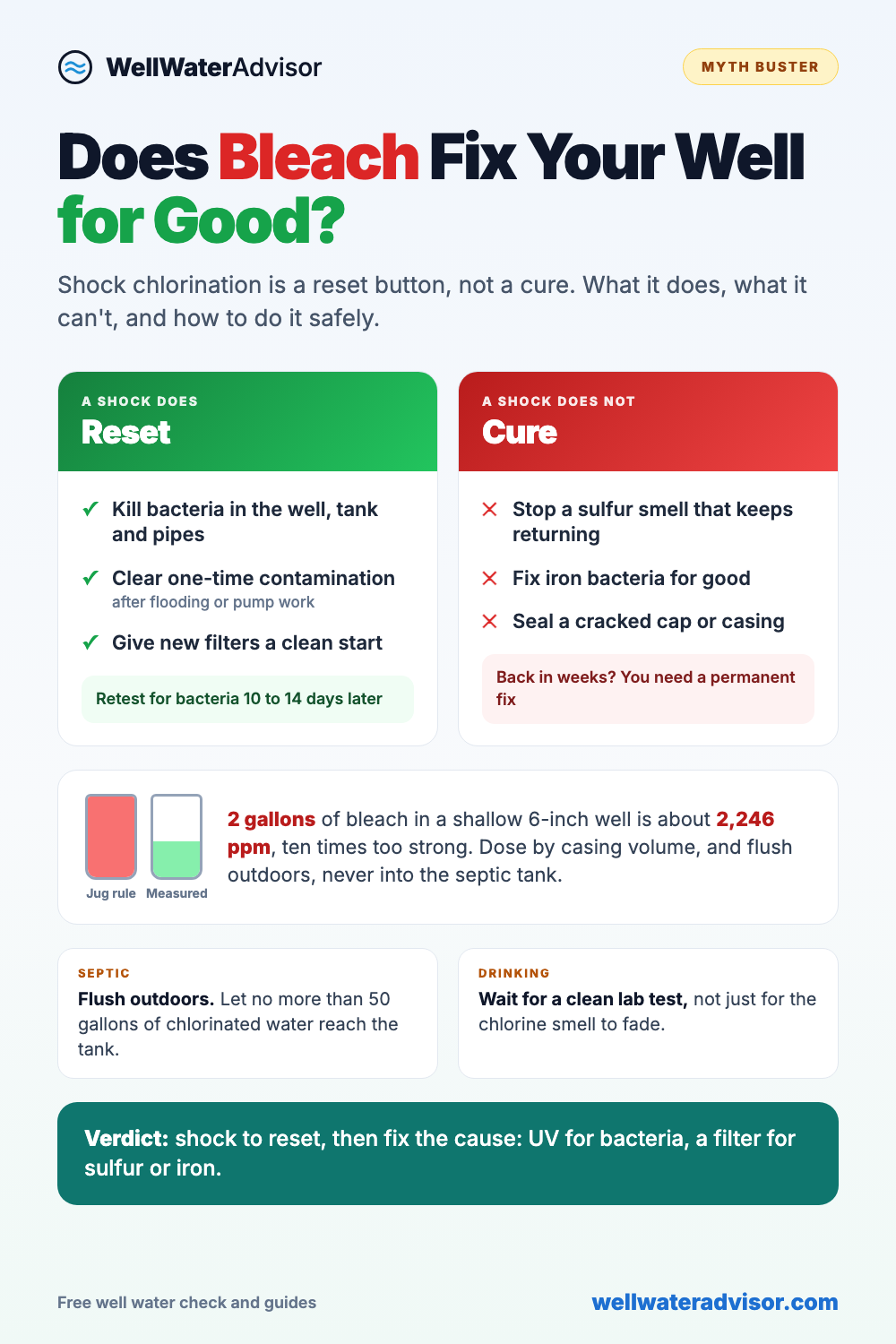
“More than plenty” is the problem. What matters is the chlorine concentration in the water, and that depends on how many gallons are standing in your casing. Extension guidance targets roughly 50 to 200 parts per million (ppm) of chlorine: the Minnesota Department of Health uses at least 50 ppm, and the University of Nebraska targets 200 ppm. Here is what a fixed amount of 8.25% bleach actually produces in a common 6-inch well, which holds about 1.5 gallons per foot of water:
| Standing water in a 6-inch well | 1 quart of bleach | 1 gallon of bleach | 2 gallons of bleach |
|---|---|---|---|
| 50 ft (about 73 gallons) | 281 ppm | 1,123 ppm | 2,246 ppm |
| 100 ft (about 147 gallons) | 140 ppm | 562 ppm | 1,123 ppm |
| 200 ft (about 294 gallons) | 70 ppm | 281 ppm | 562 ppm |
| 400 ft (about 588 gallons) | 35 ppm, too weak | 140 ppm | 281 ppm |
The same jug can be more than ten times too strong in a shallow well and too weak in a deep one.
What Happens If You Put Too Much Bleach in a Well?
Many homeowners pour extra bleach as a safety margin. It does not work that way:
- It can disinfect worse, not better. Bleach is alkaline, and Maine’s drinking water program notes that chlorine loses much of its killing power as pH rises: it estimates chlorine is fully effective at pH 5.5 but only about a third as effective at pH 7.6, and about 10 percent at pH 8.1. The University of Georgia recommends a solution pH of 6 to 7.
- Flushing takes much longer. Maine’s guidance warns that bleach beyond the recommended amount only means more flushing before the system is usable, and more chlorinated water to keep away from your septic system, lawn and garden.
- It is harder on the system. Very strong chlorine sitting in the plumbing is tougher on rubber parts such as pressure tank bladders and fixture seals.
- It does not fix the cause. If bacteria or odors return, the problem is how they get in or live in the aquifer, not the size of the last dose.
If you already overdosed, do not add anything else to the well. Flush outdoors in stages, away from the septic drain field, until the chlorine smell is gone and a test strip reads near zero.
Use plain, unscented household bleach. Scented, splash-less and “color safe” formulas contain additives you do not want in a well, and some contain far less chlorine.
Step 0: Confirm Your Numbers
Test before you shock, and again after. Shock chlorination treats bacteria, not chemistry. Before: a lab test for total coliform and E. coli confirms whether bacteria are really the problem, and a quick screen for iron, hardness and pH tells you what else is going on. After: retest for bacteria 10 to 14 days after shocking, then again in two to three months. Our guide explains how to test well water step by step.
How to Shock a Well, Step by Step
This is the sequence most state health departments and extension services describe. Check your own state’s instructions too, and call a licensed well contractor if your wellhead is buried, in a pit or hard to open safely.
- Prepare the system. Bypass or remove carbon filters and reverse osmosis units, and check the manuals for your softener, iron filter and UV system. Drain the water heater so chlorinated water can reach the hot water lines. Keep a bucket of clean water nearby, and wear gloves and eye protection.
- Add the bleach. Mix the calculated amount with a few gallons of water and pour it into the well, then rinse down the inside of the casing.
- Recirculate. Connect a garden hose to an outside faucet, run it until you smell chlorine, then put the hose back into the well casing. The Minnesota Department of Health recommends recirculating for about 30 minutes after you first smell chlorine at the hose, and checking with high-range chlorine test strips that the water reads at least 50 ppm.
- Pull it through the house. Open each faucet, hot and cold, one at a time, plus each toilet, shower and outdoor spigot, just until you smell chlorine, then close it. Running them only briefly keeps chlorinated water out of the septic tank.
- Wait. Leave the chlorinated water in the system for at least several hours; overnight, or the 12 hours our calculator page recommends, is better. Do not drink or cook with the water during this time.
- Flush outdoors. Run an outside hose onto gravel or bare ground, away from the septic drain field, gardens, streams and ponds, until the chlorine smell is gone. Then run each indoor faucet briefly to clear the lines.
- Retest. Take a bacteria sample 10 to 14 days later, as Penn State Extension recommends, and again in two to three months.
Recirculating is the step most homeowners skip, and it matters. Bleach poured into the top of a well does not mix evenly through a long column of water on its own; sending the water back down the casing mixes it and also washes the chlorine over the inside of the casing and the pump.
What If There’s No Bleach Smell After Shocking?
If you recirculate and never smell chlorine at the hose, or the smell fades within minutes, the chlorine is being used up or was never strong enough:
- The dose was too small for the water actually standing in the casing, which is common when the depth or casing size was a guess.
- Something in the water is consuming it. Iron, manganese, hydrogen sulfide, organic matter and biofilm all react with chlorine, and a dirty well can use up a normal dose quickly.
- The bleach was weak. Bleach loses strength as it ages, especially in heat, so use a fresh, unscented jug.
Do not rely on your nose alone. The Minnesota Department of Health recommends high-range chlorine test strips at the hose: if the water reads below 50 ppm, add more bleach and recirculate again. A well that keeps eating chlorine usually has an iron, sulfur or biofilm problem that a single shock will not solve; see the permanent fixes below.
Alternative Disinfection: Can You Shock a Well Without Bleach?
Yes, but “without bleach” usually still means chlorine. The health department in Orange County, North Carolina, lists 65 to 75 percent calcium hypochlorite as an alternative to liquid bleach, and Virginia Tech’s guide covers calcium hypochlorite pellets or powder dissolved in water. If you go that route:
- Use a product that lists calcium hypochlorite as the active ingredient and is certified to NSF/ANSI Standard 60 for drinking water.
- Avoid pool and spa chlorine with stabilizers, algaecides, fungicides or clarifiers; those additives do not belong in a well.
- Never mix calcium hypochlorite with acids or other chemicals, and follow the label and your health department’s dose.
There is no proven chlorine-free way for a homeowner to shock a well. A UV system disinfects water continuously as it enters the house, which is often the better long-term answer, but it does not clean the well, pump or pressure tank itself.
Cost to Shock a Well: DIY vs. Hiring a Professional
Doing it yourself is cheap: a jug or two of unscented bleach, a garden hose and a pack of high-range chlorine test strips usually cost well under $50. Add the follow-up bacteria test, which runs about $15 to $40 through many county programs and labs (see our well water testing guide for current options). Angi’s cost guide puts professional well shocking at roughly $80 to $200, with lab testing and any pump work extra.
Paying a licensed well contractor is worth it when the wellhead is buried or in a pit, the cap is hard to open safely, the well is low-yield, your area has naturally high arsenic, or bacteria came back after a previous shock. A pro can also inspect the cap, seal and casing, which is usually where recurring contamination gets in.
Protecting Your Septic System
“Be careful if you have a septic system as well. Chlorine is bad for your septic. It kills the good bacteria that you need to break down waste.”
Reply, r/WaterTreatment
That advice is right. A septic tank depends on bacteria to break down waste, and shock-strength chlorine kills them. The University of Nebraska’s guidance is to let no more than 50 gallons of chlorinated water reach the septic system. In practice that means:
- Run indoor faucets and toilets only until you smell chlorine, never for the full flush.
- Do all the real flushing through a garden hose outdoors, onto gravel or bare ground away from the drain field, your well, gardens and any stream or pond.
- Do not run the dishwasher or washing machine while the system is chlorinated.
- If you have a water softener or iron filter that backwashes to the septic system, follow its manual: many can be bypassed during the shock.
Will Bleach Damage the Water Heater, Toilets or Filters?
In the same thread, the answer to whether toilets and the water heater would be harmed was short: “no, it won’t hurt anything.” That is mostly true, with a few exceptions worth knowing:
- Water heater and toilets: extension guides tell you to run chlorinated water through both, because bacteria live there too. The diluted solution sitting overnight is the standard procedure. Never pour undiluted bleach into a toilet tank or water heater.
- Carbon filters and reverse osmosis: remove or bypass them. Chlorine uses up carbon and can damage RO membranes.
- Pressure tank: the University of Nebraska notes the rubber air-water separator inside some tanks can be damaged by the chlorine solution, so check the tank maker’s instructions.
- Softeners, iron filters and UV systems: follow each manual. Some can be sanitized with chlorine, others should be bypassed.
One more water heater note: if the rotten egg smell is only in your hot water, the cause may be the heater’s anode rod rather than the well, and shocking the well will not fix it. Our guide to hot water that smells like rotten eggs explains the anode swap.
Will Flushing Run My Well Dry?
The original poster worried that flushing every fixture until the chlorine was gone would mean “nearly running the well dry.” A reply reassured them that the well draws from the same aquifer as the neighbors and that “it’s highly improbable you’d run it dry.”
For most wells that is true: the aquifer refills the casing as you pump. But it is not true for every well. Low-yield wells, common in some bedrock areas, can be pumped down faster than they recover. The Minnesota Department of Health advises shutting off power to the pump and calling a licensed well contractor if the flow drops significantly while you flush. To be safe:
- Flush in stages, for example an hour at a time with breaks, if you know your well is slow to recover.
- Stop if the water sputters, spits air or the flow weakens.
- Spread the flushing over a day or two if needed; there is no benefit to rushing it.
When Is the Water Safe to Drink Again?
Not when the chlorine smell is gone. The smell only tells you the chlorine has been flushed out; it says nothing about whether the bacteria are gone. The University of Nebraska’s guidance is not to drink the water until a laboratory confirms no coliform or E. coli bacteria are present. Penn State Extension recommends the first retest about 10 to 14 days after shocking and another two to three months later.
Until then, use bottled water or boil drinking water for one minute. Boiling is the right stopgap for bacteria, but it does not remove chemicals like nitrate or arsenic; see when boiling helps and when it does not.
A Hidden Risk: Temporary Arsenic Release
In areas with naturally arsenic-rich rock or sediment, chlorinating a well can briefly raise arsenic in the water. The University of Georgia notes that shock chlorination may temporarily increase arsenic levels in such areas, and a Wisconsin study found temporary increases, likely from disturbed biofilm and mineral crusts, that generally fell again once the well was thoroughly flushed.
- Do not leave the chlorine in the well longer than the 12 to 24 hours most guides call for.
- Flush thoroughly before using the water again.
- If arsenic is common where you live, include arsenic in your post-shock lab test. Our county well water reports for Florida and California show how often local wells exceed the 10 µg/L limit.
Why the Smell or Bacteria Come Back
Shock chlorination is a sanitizer, not a filter. It kills what is in the well and plumbing at that moment, and then the chlorine is flushed away. Penn State Extension describes it as a treatment for one-time contamination, such as bacteria introduced during a pump repair or after heavy runoff, and reports that in one study, shocking plus a sanitary well cap kept coliform bacteria away for a year in only 15 percent of wells. If bacteria come back on either retest, Penn State says a continuous disinfection system is needed.
Odors follow the same pattern. The University of Georgia notes that a sulfur smell may return even after shock chlorination. Sulfate-reducing bacteria live in the aquifer and the well, and a single shock only knocks them back. Iron bacteria, the source of orange slime and swampy smells, regrow the same way.
| Problem that keeps coming back | Why shocking alone fails | Permanent fix |
|---|---|---|
| Coliform or E. coli after retest | Surface water is still getting in | Fix the cap, casing or grading, then add continuous disinfection such as UV |
| Rotten egg smell in hot and cold water | Sulfur bacteria or dissolved hydrogen sulfide in the aquifer | Aeration, an oxidizing filter or chlorine injection; see sulfur smell treatment options |
| Orange slime, rust stains, swampy smell | Iron bacteria feeding on dissolved iron | Iron removal sized to your test; see iron in well water |
| Rotten egg smell in hot water only | Water heater anode rod reaction | Aluminum-zinc or powered anode |
Shock chlorination is still the right first step in each case: it clears the system so a filter or UV unit starts clean, and it tells you how fast the problem returns. Repeated shocking every few weeks is the sign you need one of the permanent fixes above.
How Often Should You Shock Your Well?
Only when something calls for it. Virginia Tech Extension describes shock chlorination as required after a new well is built and recommended after a positive total coliform test or any maintenance or repair of the water system. Other good reasons:
- After flooding reaches the wellhead, once the water has gone down.
- After the well cap, pump or pressure tank has been opened or replaced.
- When a sudden change in smell, taste or color points to bacteria, ideally confirmed by a test first.
Routine shocking on a calendar is not a substitute for testing. Health Canada’s guidance, as summarized by Canada’s National Collaborating Centre for Environmental Health, is that shock chlorination alone does not guarantee safe water and belongs in a program of regular testing and well maintenance. Test for bacteria at least once a year; if you find yourself shocking more than once or twice a year, install continuous treatment instead.
Equipment for Shocking and for the Permanent Fix
These are the equipment types this guide recommends. We have not tested individual models hands-on; the links open Amazon listings so you can compare current models against your test results.
Before and after the shock
Well Water Bacteria Test Kit
Confirms the problem first, then whether the shock worked.
- Retest 10 to 14 days after shocking
- A certified lab test is the most reliable
When bacteria keep coming back
Whole House UV Disinfection System
Continuous disinfection after the shock, with no chemicals.
- Kills bacteria at every tap, every day
- Needs clear water: filter iron and sediment first
For recurring sulfur smell or iron bacteria
Chlorine Injection (Feed Pump) System
Continuous low-dose chlorine instead of repeated shocks.
- Oxidizes sulfur and iron as well as disinfecting
- Pair with a contact tank and carbon filter
Chemical-free sulfur and iron removal
Air Injection (AIO) Iron and Sulfur Filter
Removes rotten egg smell and iron without chlorine.
- No chemicals: air does the oxidizing
- Treats the whole house
Frequently Asked Questions
Can I shock my well if I have a septic system?
Yes, but keep the chlorinated water out of the septic tank. Run indoor faucets and toilets only until you smell chlorine, then do all the flushing through an outdoor hose onto gravel or bare ground away from the drain field. University of Nebraska guidance limits chlorinated water entering a septic system to 50 gallons.
How long after shocking a well can you drink the water?
Not until a lab test confirms no coliform or E. coli bacteria, even if the chlorine smell is gone. Retest about 10 to 14 days after shocking, as Penn State Extension recommends, and use bottled or boiled water until the result is clean.
Why does my well still smell after shock chlorination?
Shocking only knocks back the sulfur bacteria and iron bacteria living in the well and aquifer, so the smell often returns within weeks. If the smell is only in hot water, the water heater anode rod is the likely cause. A recurring smell needs a permanent fix such as aeration, an oxidizing filter or chlorine injection.
How much bleach do I need to shock my well?
It depends on how much water stands in the casing, not a fixed jug. Extension guidance targets roughly 50 to 200 ppm of chlorine. A 6-inch well holds about 1.5 gallons per foot of water, so the right amount can range from under a quart to more than a gallon of 8.25% bleach. Our shock chlorination calculator works it out from depth and casing diameter.
What happens if you put too much bleach in a well?
It does not work better. Bleach is alkaline, and chlorine loses much of its disinfecting power as pH rises, so a big overdose can be less effective. It also means far more flushing and more chlorinated water to dispose of, and it is harder on rubber parts such as pressure tank bladders.
How often should I shock my well?
Only when there is a reason: a positive bacteria test, flooding, or work on the well or pump. Routine shocking is not recommended. If you need to shock every few weeks to control bacteria or odor, install a continuous solution such as UV disinfection or chlorine injection instead.
Can you shock a well without bleach?
Yes, with calcium hypochlorite granules or tablets certified to NSF/ANSI 60 instead of liquid bleach. Avoid pool chlorine with stabilizers, algaecides or other additives. There is no proven chlorine-free way for a homeowner to shock a well; UV disinfection protects the house continuously but does not clean the well itself.
How much does it cost to shock a well?
Doing it yourself usually costs well under $50 for unscented bleach, a hose and chlorine test strips, plus about $15 to $40 for the follow-up bacteria test. Angi puts professional well shocking at roughly $80 to $200, with lab tests and pump work extra.
Will shock chlorination damage my water heater or toilets?
Not at the diluted strength used for shocking. Extension guides tell you to run the chlorinated water through the water heater and toilets because bacteria live there too. Remove carbon and reverse osmosis filters, and check the manuals for your pressure tank, softener and UV system before you start.
Sources and How We Researched This
This guide was compiled by the WellWaterAdvisor editorial team from state health department and university extension guidance. Community quotes are reproduced from a public r/WaterTreatment thread and credited to the subreddit. Procedures vary by state, so check your own state’s well disinfection instructions and call a licensed well contractor for buried or hard-to-reach wellheads.
- Minnesota Department of Health: Well Disinfection (recirculation, 50 ppm check, low-flow warning)
- University of Nebraska–Lincoln Extension G1761: Shock Chlorination of Domestic Water Supplies (200 ppm target, 50-gallon septic limit, water heater, filters, pressure tank)
- Penn State Extension: Shock Chlorination of Wells and Springs (retest timing, 15 percent study, continuous disinfection)
- Maine CDC Drinking Water Program: Shock Chlorination of Bedrock Wells (pH and excess bleach)
- University of Georgia Extension C858-4: Disinfecting Your Well Water (retesting, solution pH, arsenic precautions)
- University of Wisconsin Water Resources Institute: Importance of Disinfection on Arsenic Release from Wells
- Virginia Tech Extension: Shock Chlorination: Disinfecting Private Household Water Supply Systems (when to shock, calcium hypochlorite)
- National Collaborating Centre for Environmental Health: Review of Guidelines for Shock Chlorination
- Orange County, NC Health Department: Disinfection of Wells (calcium hypochlorite, no pool additives)
- Angi: Cost to Shock a Well
- University of Georgia Extension: Rotten Egg Smell (smell recurrence, anode rods)
Related tools: shock chlorination calculator, well water diagnostic calculator, how to test well water.