This guide contains affiliate links. As an Amazon Associate we earn from qualifying purchases, at no extra cost to you. Read our full affiliate disclosure.
In this guide
Where the Myth Comes From
“Salt-free water softener” is a marketing name, not a technical one. The Water Quality Association defines soft water as less than 1 grain per gallon (gpg) of hardness, and a water softener as a device that gets water below that line, by any method. Salt-free systems are designed to do something else: keep hardness minerals from forming scale while leaving them in the water. As one industry review of the WQA definitions put it, if a device does not remove the hardness, it is not a softener, no matter how well it controls scale.
That is why both camps sound convincing. Owners who wanted less scale in the water heater often say salt-free works. Owners who expected the slippery feel and spot-free glassware of a real softener say it does nothing. They are describing two different jobs.
Why Some Plumbers Call Them Snake Oil
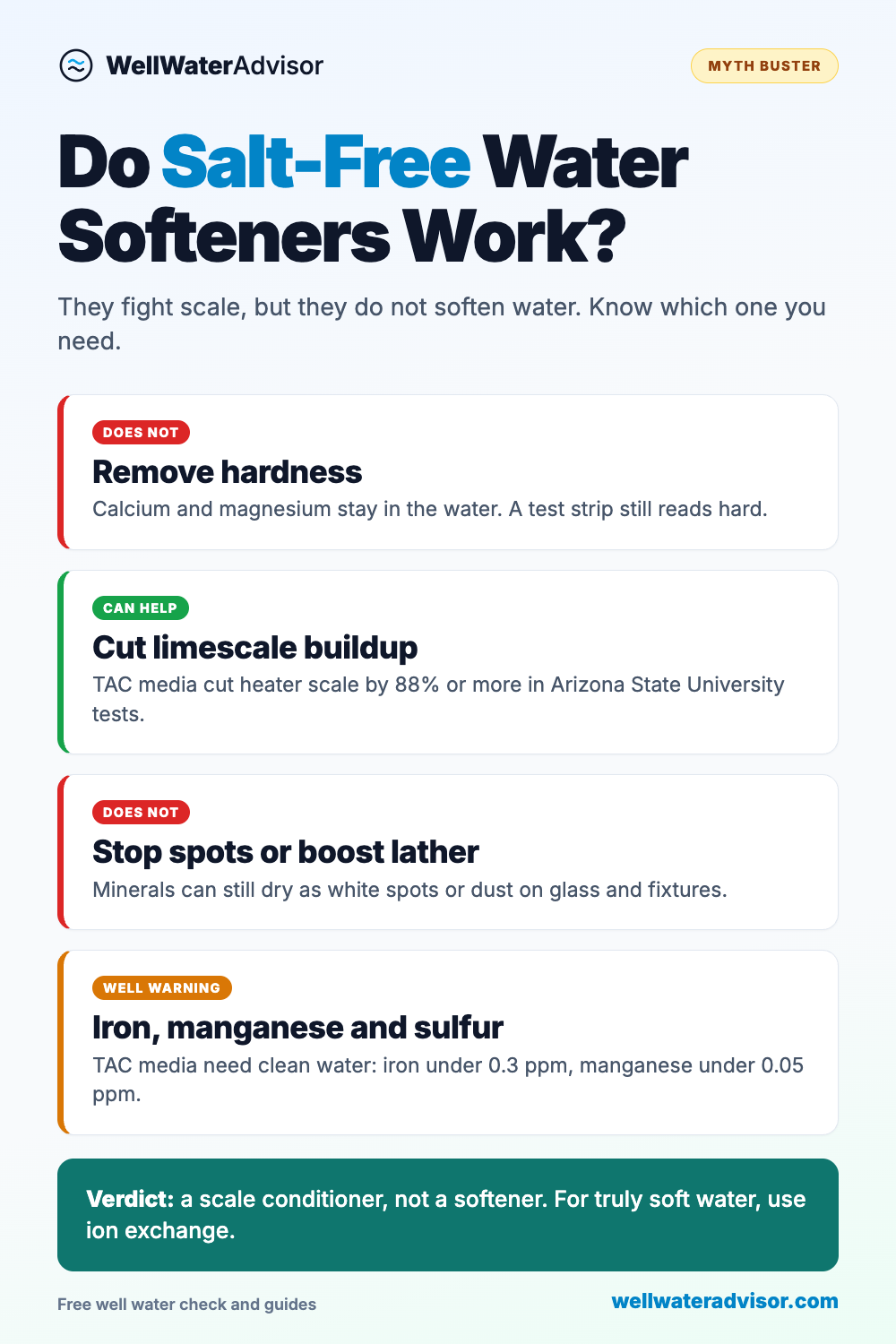
Ask a plumber about salt-free softeners and you may hear “snake oil.” That reaction usually comes from two kinds of service calls. In the first, a homeowner installs a salt-free unit, dips a hardness test strip, sees the same 15 gpg as before and decides the system is broken. In the second, the customer expected the slick, slippery feel of softened water in the shower and never got it.
The same story is familiar on homeowner forums such as r/WellWater and r/HomeImprovement. A new owner posts that the strip reads exactly what it did before the install and asks whether the unit is defective or whether they were sold snake oil. The replies that know the technology tend to say the same thing: the strip is working, the system is working, and the two are measuring different things.
Both judge a scale conditioner by softener rules. A hardness test counts dissolved calcium and magnesium, and a salt-free system is not designed to remove them, so the number should not move. The slippery feel comes from swapping hardness for sodium, which TAC does not do. The fair test is the job it claims to do: look at the water heater element, a kettle or a showerhead after several months and compare it with what you saw before.
Part of the skepticism is earned. Clamp-on magnets and some electronic boxes are sold under the same “salt-free” label with much weaker evidence, which is why the table below separates the technologies.
Salt-Free Technologies Compared
“Salt-free” covers several very different technologies. The University of Nebraska’s extension guide on salt-free options and an Arizona State University study for the WateReuse Research Foundation give the clearest independent picture:
| Technology | How it works | Evidence | Removes hardness? |
|---|---|---|---|
| Template-assisted crystallization (TAC) | Treated beads seed microscopic crystals that do not stick as scale | Strongest: 88% or more scale reduction in ASU tests | No |
| Electronic and electromagnetic | Coil or field around the pipe changes how scale forms | Mixed: about 50% reduction in ASU tests, softer scale | No |
| Clamp-on magnets | Permanent magnets on the pipe | Unproven: no scientific consensus | No |
| Capacitive deionization | Electrically charged electrodes pull ions out of the water | Effective, but rare and costly for homes | Partly, to about 5 gpg |
| Ion exchange softener (for comparison) | Resin swaps calcium and magnesium for sodium or potassium | Proven and certifiable | Yes, below 1 gpg |
The Nebraska guide is blunt about magnets: it calls magnetic water treatment unproven technology without a strong scientific basis. If a product only clamps onto the outside of a pipe, treat its claims with the same caution.
How TAC Actually Works
A TAC conditioner is a tank of polymer beads with a specially treated surface. As water flows up through the tank, the beads tumble and their surface acts as a template where dissolved calcium carbonate starts to crystallize. The crystals grow to microscopic size, break off and travel through the plumbing as stable particles instead of building up as hard scale on hot surfaces. The minerals are converted, not removed.
In the Arizona State University tests, run with identical water heater rigs and an untreated control, TAC reduced scale by more than 88 percent, and by more than 90 percent on Colorado River water. One of the test waters was Scottsdale groundwater at roughly 450 to 500 mg/L of hardness, about 26 to 29 gpg, so TAC can handle genuinely hard water. Electronic and electromagnetic units in the same study cut scale by only about half.
The crystals are microscopic, far smaller than a grain of sand. They break free of the media and travel with the water instead of growing on hot surfaces. TAC makers describe them as stable calcium carbonate crystals, typically in the aragonite form, that do not dissolve back and re-deposit as hard scale. Some brands sell the same idea as NAC (nucleation assisted crystallization) media.
TAC conditions water as it flows through the tank, which suits normal household use. Water that sits for long periods in a heater tank, kettle or on a fixture can still leave a light residue, but it is soft and powdery rather than the rock-hard scale that coats untreated heating elements.
What Salt-Free Systems Cannot Do
- Make water soft: a hardness test before and after reads about the same. If you test your water to check the system, that is expected, not a fault.
- Stop spots and film: the minerals are still in the water, so they can still dry on glass and shower doors. The Nebraska guide notes a fine dust may form on dishes that wipes away. In practice it is a dry mineral powder that usually comes off glass and fixtures with a microfiber cloth, unlike hard scale baked onto a dishwasher or kettle.
- Improve lather: no independent studies confirm that salt-free devices fix poor soap and detergent performance.
- Remove contaminants: they do not treat bacteria, hydrogen sulfide, sand, lead, nitrate or pesticides, and they are not designed to remove iron or manganese.
- Prove themselves on paper: ion exchange softeners can be certified to NSF/ANSI standards, but the Nebraska guide notes that standards for household no-salt devices are still being developed, so independent proof for a specific product is often missing.
What they do well is the job a lot of buyers actually care about: protecting the water heater, kettles, faucets and fixtures from hard scale, with no salt to carry, no brine discharged to a septic system and no sodium added to the water.
They also need no electricity, no drain line and no regeneration cycle, so no water is sent down the drain. A conventional softener flushes brine and rinse water to the drain or septic system every time it regenerates. That difference matters in parts of California, where state law lets local agencies restrict salt-discharging softeners to protect recycled water, and for well owners who would rather keep brine out of a septic system.
Salt-Based vs Salt-Free: Side-by-Side Comparison
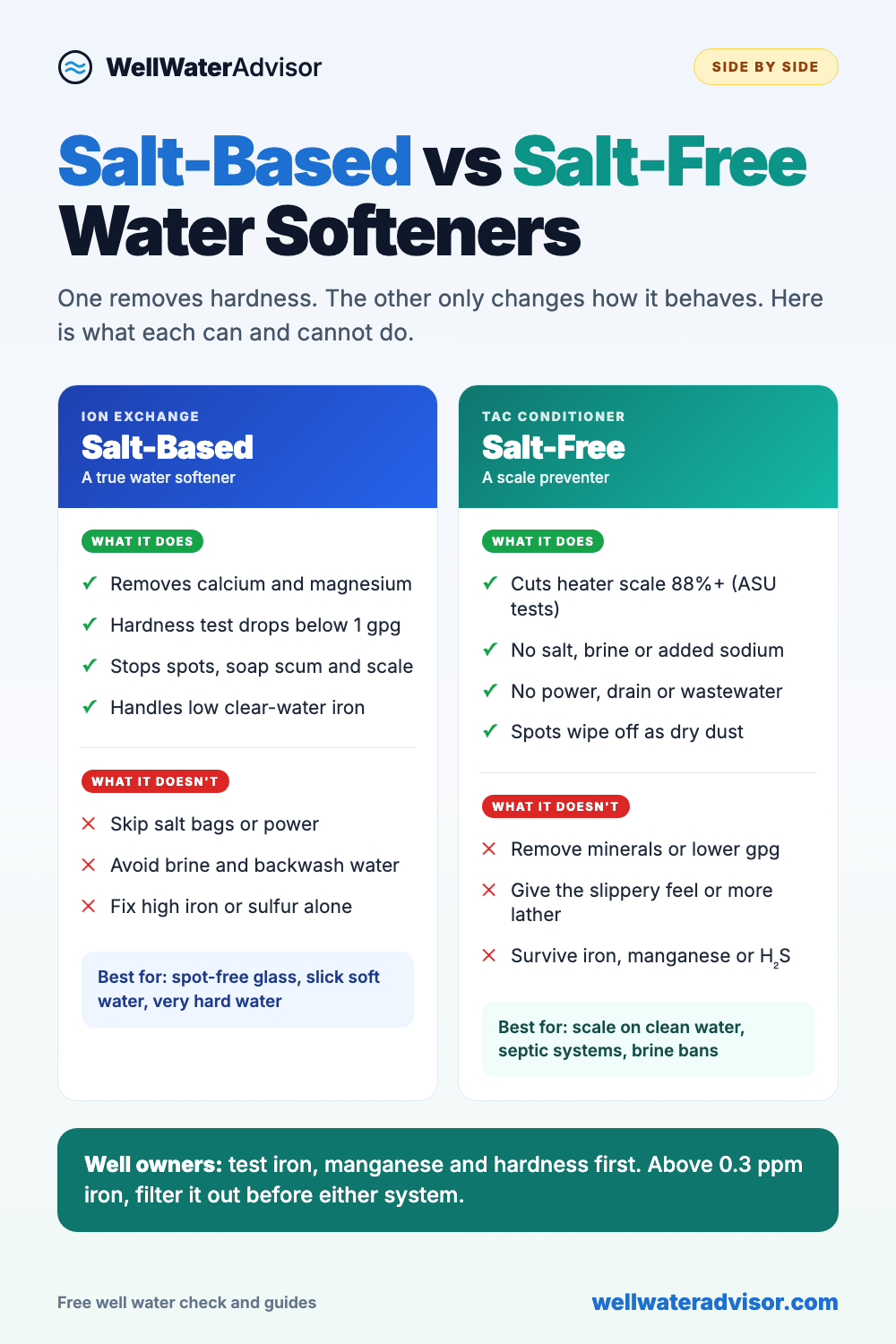
Here is how a conventional ion exchange softener and a TAC conditioner compare on the points that matter most to well owners.
| Feature | Salt-based (ion exchange) | Salt-free (TAC) |
|---|---|---|
| Mineral removal | Yes, removes calcium and magnesium | No, minerals stay in the water |
| Scale prevention | Near complete, the hardness is gone | 88% or more in ASU water heater tests |
| Salt required | Yes, salt or potassium bags | None |
| Water wasted | Brine and rinse water every regeneration | None, no backwash or drain |
| Electricity and drain | Needs both for the control valve | Neither |
| Maintenance | Refill salt, clean resin now and then | Sediment filter changes, new media every few years |
| Hardness test change | Drops below 1 gpg | No change, by design |
| Lather and feel | More lather, slippery feel | No change |
| Iron handling | Low clear-water iron, up to about 3 ppm | Fouled above 0.3 ppm; some makers allow none |
The Well Water Problem: Iron, Manganese and Sulfur
Most salt-free marketing assumes clean city water. Wells are different. TAC media need relatively clean water, and the Nebraska guide notes pretreatment is required when iron, manganese or sediment are present. TAC manufacturers typically specify iron below 0.3 ppm and manganese below 0.05 ppm, because these metals coat the bead surface and shut down the crystal-seeding sites. Hydrogen sulfide and sediment cause similar trouble.
That rules out a salt-free system as the only treatment on many wells. If your water has iron above 0.3 ppm, you have two options: an iron filter system in front of the salt-free unit, or an ion exchange softener, which handles hardness plus up to about 1 to 3 ppm of clear-water iron. Our Myth Buster on whether a water softener removes iron explains where that limit comes from.
Salt-Free or Salt-Based: Check Your Water
Pick what you want to fix and enter your test results. The check flags anything that would foul salt-free media, compares both options side by side and sizes a softener with the same formula as our water softener size calculator.
Interactive check
Salt-Free or Salt-Based: Which Fits Your Water?
Pick what you want to fix and enter your test results. The check flags water that would foul salt-free media and sizes a softener if that is the better fit.
Hardness in mg/L or ppm? Divide by 17.1 to get gpg. Leave iron blank if you have not tested it.
Which One to Choose
| Your situation | Best choice | Why |
|---|---|---|
| Scale is the main problem, iron under 0.3 ppm, no sulfur smell | Salt-free (TAC) | Cuts hard scale with no salt, brine or sodium |
| You want spot-free glass, less soap scum and better lather | Ion exchange softener | The only option that takes water below 1 gpg |
| Hard water plus 0.3 to 3 ppm clear-water iron | Ion exchange softener | Removes hardness and low iron in one tank; salt-free would foul |
| Iron over 3 ppm, manganese or rotten-egg smell | AIO iron filter first | Then either a softener or a salt-free conditioner after it |
| Local softener ban, septic worries or a low-sodium diet | Salt-free, or a potassium softener | No brine with TAC; potassium chloride avoids added sodium |
| Under 3.5 gpg hardness | Neither | Too little hardness to cause much scale |
Step 0: Confirm Your Numbers
Iron type and iron level decide everything on this page, so test before you buy. DIY screening: a 16-in-1 or 17-in-1 well water test strip kit reads iron, hardness and pH in minutes. Certified testing: strips read total iron only, so for exact ppm, manganese and bacteria use a state-certified drinking water lab. Our guide explains how to test well water step by step.
Equipment That Matches Each Scenario
These are the equipment categories this guide recommends. We have not tested individual models hands-on. Where we name a model, its specs come from the manufacturer’s published spec sheet; the links open Amazon listings so you can compare current models against your test results, hardness rating and flow rate.
Salt-free pick for clean water
SpringWell FutureSoft Salt-Free Conditioner
TAC media rated to 81 gpg; SpringWell claims up to 95% scale prevention.
- No salt, power, drain or wastewater
- Lifetime defect warranty if water meets spec (no iron, manganese or H2S)
Salt-based pick for truly soft water
SpringWell SS1 Salt-Based Softener
32,000-grain ion exchange for 1 to 3 bathrooms; size up for very hard water.
- Hardness below 1 gpg and the slick soft-water feel
- Lifetime defect warranty, 5 years on the valve head
Needed for iron, manganese or sulfur
Air Injection (AIO) Iron Filter
Install it first so neither system fouls.
- No salt or chemicals: air does the oxidizing
- Also clears rotten-egg sulfur smell
Recommended before TAC
Whole House Sediment Filter
Keeps sand and grit off the TAC media and valves.
- Protects the media bed
- Low-cost cartridges, quick swaps
Frequently Asked Questions
Do salt-free water softeners really work?
They work for scale, not for softening. Template-assisted crystallization (TAC) cut water heater scale by 88 percent or more in Arizona State University testing, but the hardness minerals stay in the water, so spots, soap scum and lather barely change.
What is the difference between a water softener and a salt-free conditioner?
A water softener removes hardness, taking it below 1 grain per gallon with ion exchange. A salt-free conditioner leaves calcium and magnesium in the water and changes their form so they are less likely to stick as scale.
Will a salt-free system get rid of water spots?
Usually not. The minerals are still in the water, so they can still dry as spots or a fine dust on glass, dishes and shower doors. Only a softener or reverse osmosis removes them.
Can I use a salt-free water softener on well water?
Only if the water is clean enough. TAC media typically need iron below 0.3 ppm, manganese below 0.05 ppm, no hydrogen sulfide and little sediment. Otherwise install an iron filter first or choose an ion exchange softener.
Do magnetic water softeners work?
There is no scientific consensus that they do. The University of Nebraska extension guide calls magnetic water treatment unproven, and electronic units cut scale by only about half in Arizona State University tests.
Will my water test still show hard water after a salt-free system?
Yes. Salt-free systems do not remove hardness, so a test strip or lab test reads about the same before and after. That is expected and not a sign the system has failed.
Does a salt-free system add sodium to the water?
No. TAC adds nothing to the water. A conventional softener adds sodium in exchange for hardness; running it on potassium chloride instead of salt avoids that.
How long does salt-free media last?
Each manufacturer sets its own replacement interval, usually every few years. Iron, manganese, chlorine and sediment shorten media life, so follow the spec sheet and keep pretreatment in place.
Why do plumbers call salt-free water softeners snake oil?
Mostly because they get judged as softeners. A hardness test reads the same after a salt-free system and the water never feels slippery, so it looks like nothing happened. TAC is meant to stop scale, not remove hardness, so check the water heater or a kettle after a few months instead.
Does a salt-free conditioner need electricity or a drain?
No. A TAC conditioner has no control valve to power and never regenerates, so it needs no outlet, no drain line and sends no water to the drain. A salt-based softener needs both and flushes brine every regeneration.
Sources and How We Researched This
This guide was compiled by the WellWaterAdvisor editorial team from university extension guidance, independent laboratory research and industry definitions. We did not test products hands-on. Media limits and hardness ratings vary by model, so always check the spec sheet.
- University of Nebraska–Lincoln Extension: Drinking Water Treatment: Salt-Free Water ‘Softener’ Options (G2275), Dvorak and Schuerman, revised December 2025
- Fox, P. et al., Evaluation of Alternatives to Domestic Ion Exchange Water Softeners, Arizona State University for the WateReuse Research Foundation (Project 08-06)
- Water Conditioning & Purification: What’s in a Name? (WQA definitions of soft water, softeners and saltless devices)
- SpringWell FutureSoft and SpringWell salt-based softener product pages (manufacturer specifications and warranty terms)
- California Water Code Section 13148 (local limits on salt-discharging residential softeners)
Related tools: water softener size calculator, well water diagnostic calculator, how to test well water.