Typical values from 86 sampled wells in Lafayette County · Full groundwater profile
Quick Answers for Lafayette County Well Owners
Arsenic above the drinking water limit. Arsenic exceeded the 10 µg/L limit in 11% of 85 sampled Lafayette wells. It has no taste or smell, so only a lab test shows whether your well is affected.
Safe to drink? Only after a lab test that includes arsenic.
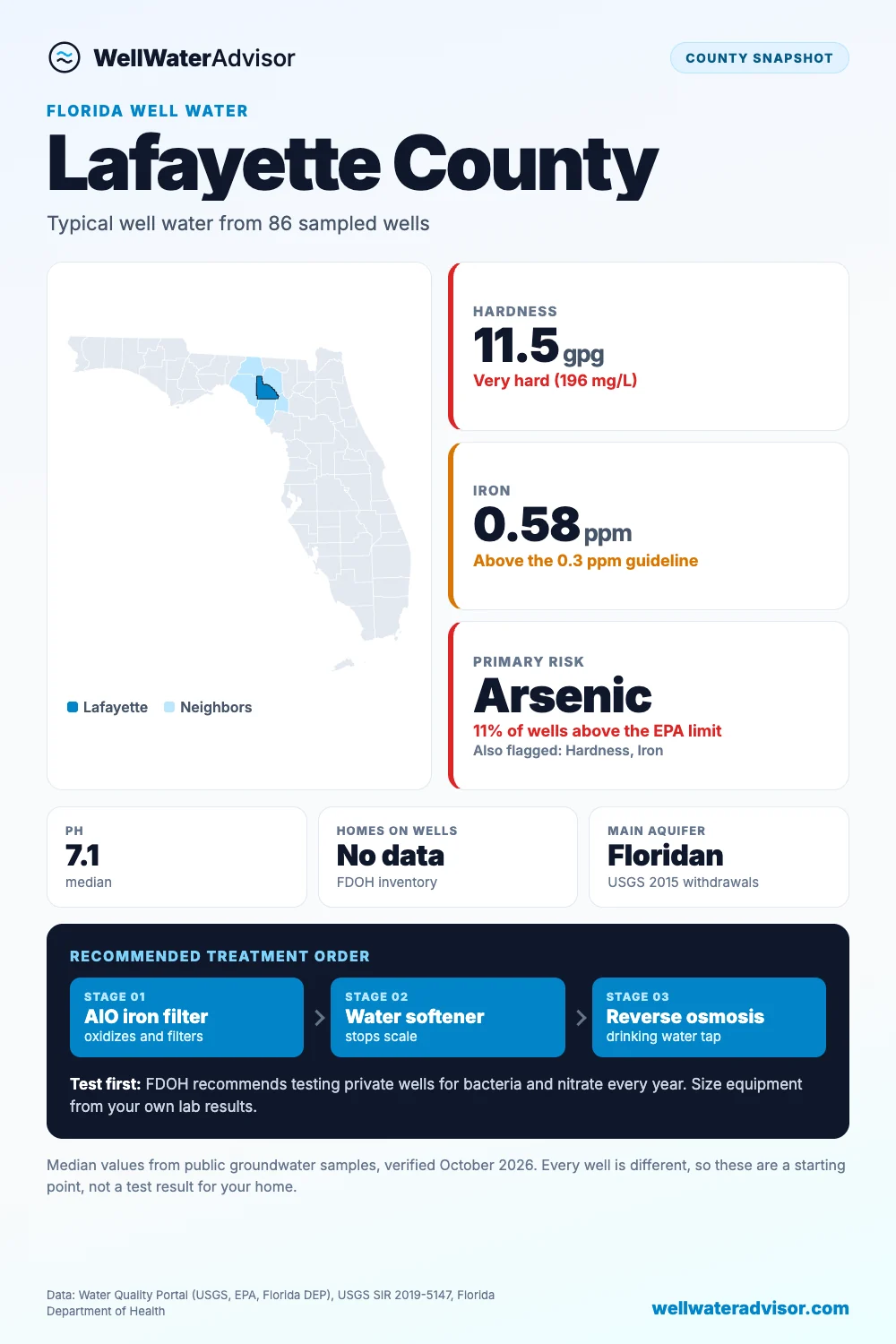
What a typical home here installs:
- A spin-down or cartridge sediment filter first, so sand and scale do not foul the stages after it.
- An oxidizing iron filter for the 0.58 ppm iron, ahead of any softener.
- A 32,000-grain water softener for a family of four at 11.5 gpg (includes 5 gpg per ppm of iron).
- Point-of-use RO filtration for drinking water, but only after a lab test confirms the problem in your well.
See how a well water filtration system is laid out. Your own test result decides the final list.
Not sure what to install? Get a filter recommendation for Lafayette County homesIf your water comes from a utility, its annual Consumer Confidence Report is the right source; the figures here are for private wells. Find your utility's report
On this page (7 sections)
Where to Test Well Water in Lafayette County
- Florida Department of Health in Lafayette County: 386-294-1321, 140 SW Virginia Circle, Mayo, FL 32066. Drinking water program page
- Certified labs: how to find a state-certified lab (FDOH)
Contacts as listed on the official page, checked November 2026. Call before you go; hours and fees change.
What Are You Noticing in Your Water?
Pre-selected from Lafayette County well data. Untick anything you do not notice in your own water.
Confirm with a lab test before buying equipment.
Explore Florida Interactive Map
Explore Lafayette County and nearby counties
Lafayette County, in North Florida, is home to about 8,100 residents (2023 Census estimate). Here is what groundwater samples from local wells show, and how to test your own.
Most groundwater pumped in Lafayette County comes from the Floridan Aquifer (USGS, 2015 withdrawals). Samples from 86 local wells put the median hardness at 11.5 gpg (very hard) and median iron at 0.58 mg/L. The county's largest communities are Mayo and Day.
In this guide
Groundwater Profile: Lafayette County
Across 86 sampled wells, the median hardness is 11.5 gpg (very hard). At 11.5 gpg, Lafayette wells run harder than Madison (8.6 gpg), softer than Dixie (14.9 gpg) and about as hard as Suwannee (12.1 gpg) and Taylor (12.1 gpg) next door.
Another address? Check hardness by ZIP code.
What shows up in local well samples:
- HardnessMedian 11.5 gpg; 87% of 86 sampled wells above 7 gpg
Calcium and magnesium dissolved from limestone. Leaves scale on fixtures and water heaters and reduces soap lather. Not a health risk.
Water softener sizing - IronMedian 0.58 mg/L; 58% of 86 sampled wells above 0.3 mg/L
Stains sinks, toilets and laundry orange-brown and can taste metallic. The EPA aesthetic guideline is 0.3 mg/L. See how to choose an iron filter for your test result.
Iron filter sizing guide - Arsenic11% of 85 sampled wells above 10 µg/L
Odorless and tasteless, with an EPA limit of 10 µg/L. Only a lab test detects it.
How to test your well
How Lafayette County Compares to Florida and the U.S.
See How Lafayette County Compares to Florida & the US
| Share of wells with… | Lafayette CountyLafayette | FloridaFL | United StatesUS |
|---|---|---|---|
| Hard water (above 7 gpg) | 87% | 79% | 60% |
| Iron above 0.3 mg/L | 58% | 35% | 19% |
| Manganese above 0.05 mg/L | 11% | 8% | 21% |
| Dissolved solids above 500 mg/L | 6% | 22% | 15% |
| Acidic water (pH below 6.5) | 5% | 15% | 14% |
| Nitrate above 10 mg/L (EPA limit) | Limited data | 2% | 4% |
| Arsenic above 10 µg/L (EPA limit) | 11% | 3% | 7% |
| Median hardness | 11.5 gpg | 12.4 gpg | — |
| Median pH | 7.1 | 7.2 | 7.3 |
Sources: Water Quality Portal (since 2000); US: USGS Circular 1332. Highlighted: well above the US share.
See what a typical Lafayette County well needs
Pre-filled with the Lafayette medians. Swap in your own results.
Testing Your Well in Lafayette County
The Florida Department of Health in Lafayette County oversees private well permitting in the county and investigates suspected contamination. For routine bacteria, nitrate or full-panel tests, use a laboratory certified by the Florida Department of Health.
What to test for in Lafayette County:
- Bacteria (total coliform and E. coli) and nitrate, at least once a year (Florida Department of Health recommendation)
- Hardness in grains per gallon (gpg) to size a softener
- Iron and manganese before choosing a filter
- Arsenic, which appeared above the EPA limit in some sampled wells here
- After any flood, new well work or a change in taste, color or smell
Which tests to order and how: how to test well water.
After a positive coliform test, work out the bleach dose and shock the well and retest 10 to 14 days later.
Nearby Counties
Lafayette County borders these counties with published reports:
Dixie County
14.9 gpg hardness · Hardness, IronGilchrist County
12.2 gpg hardness · HardnessMadison County
8.6 gpg hardness · HardnessSuwannee County
12.1 gpg hardness · HardnessTaylor County
12.1 gpg hardness · Hardness, IronCounties with similar well water
Farther away, these Florida counties share the same main water issues:
Frequently Asked Questions
Is well water in Lafayette County safe to drink?
Many wells are fine, but in county records arsenic exceeded the 10 µg/L limit in 11% of 85 sampled wells. Have your water tested for these and for bacteria before you drink it untreated.
How hard is well water in Lafayette County?
Groundwater samples from 86 wells in Lafayette County have a median hardness of 11.5 grains per gallon (196 mg/L), which the USGS classes as very hard. About 87% of sampled wells are above 7 gpg, the point where a water softener is usually worthwhile. The Florida statewide median is 12.4 gpg.
Is iron a problem in Lafayette County well water?
For many homes: 58% of 86 sampled Lafayette wells are above 0.3 mg/L, with a median of 0.58 mg/L. Expect orange stains unless iron is filtered out ahead of any softener.
Is arsenic a problem in Lafayette County well water?
Yes for some wells: 11% of 85 sampled wells exceeded the 10 µg/L arsenic limit. Long-term exposure raises cancer risk, so test, and treat with reverse osmosis if needed.
Why does my well water smell like rotten eggs in Lafayette County?
Public lab records include sulfide results for only 0 wells in Lafayette, not enough to judge. The smell comes from hydrogen sulfide; a sulfide test confirms it, and at household levels it is a nuisance, not a health hazard.
Does boiling well water make it safe to drink in Lafayette County?
No, not for the arsenic found in some Lafayette wells. Boiling kills bacteria, but chemicals stay behind and become more concentrated as water evaporates. Here is why boiling cannot remove nitrate or arsenic.
How often should I test my well water in Lafayette County?
The Florida Department of Health recommends testing private wells for bacteria and nitrate at least once a year, and again after flooding or well repairs. The Florida Department of Health in Lafayette County can explain how to collect and submit samples.
Written by Well Water Advisor Editorial Team.